Life
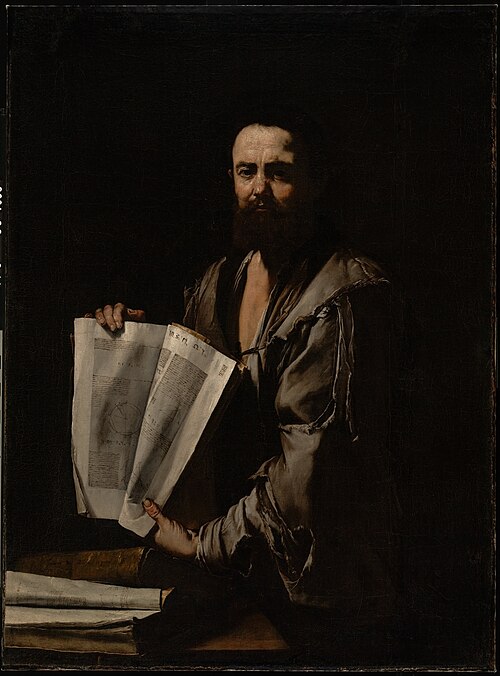
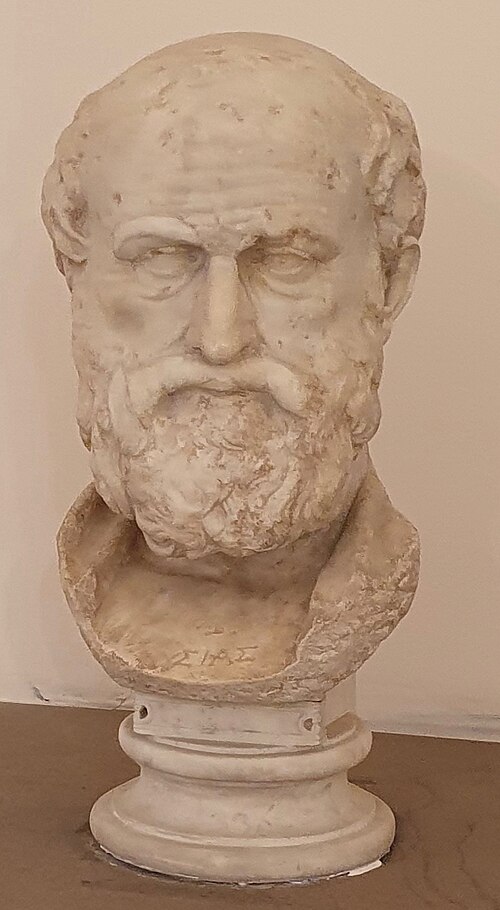
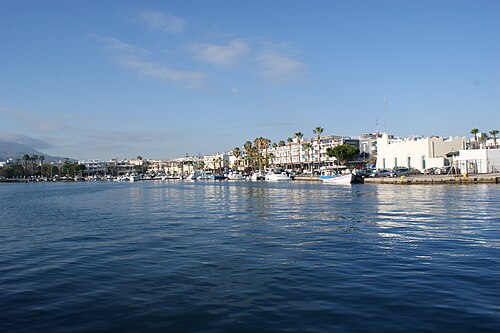
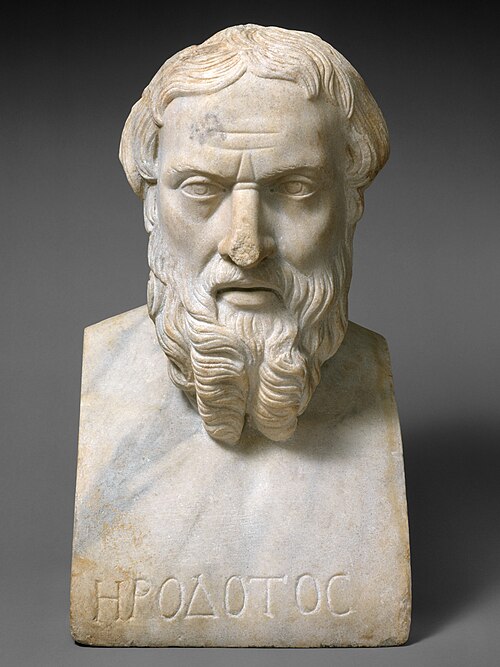
Herodotus was born around 484 BC in Halicarnassus, today Bodrum on the Turkish coast, a Greek city under Persian rule with a mixed Greek and Carian population; his own father bore the Carian name Lyxes. The family opposed the local tyrant Lygdamis, a relative of Herodotus, the epic poet Panyassis, was killed, and Herodotus spent time in exile on Samos. He seems to have returned to help overthrow the tyrant, then left for good.
What followed were the travels that fill his book: up the Nile as far as Elephantine, to Babylon, to the Scythians on the north coast of the Black Sea, to Cyrene in Libya and across the Aegean. Wherever he went he asked priests, guides and merchants what they knew, and noted when he believed them and when he did not. In Athens, at the height of Pericles' power, he gave public readings of his work, became a friend of Sophocles and, according to a later source, was voted a large reward by the city.
In 444 or 443 BC he joined the new colony of Thurii in southern Italy, which Athens was founding. He probably died there around 425 BC, though one tradition places his grave in Pella in Macedonia. He wrote in Ionic Greek, the dialect of the eastern Aegean, and his tomb epigram called him 'the lord of Ionic history'.
Works

The Ιστορίαι (Histories) set out, as the first sentence says, to record the great deeds of Greeks and barbarians so that time does not erase them, and to explain why they fought. The nine books, later named after the nine Muses by editors in Alexandria, begin with Croesus of Lydia and the wise Athenian Solon, who tells the rich king that no one can be called happy before his death. They then follow the rise of Persia under Cyrus, Cambyses, Darius and Xerxes, with long digressions on the lands they conquered: Egypt with its pyramids, crocodiles and embalmers takes up the whole of Book 2.
Books 6 to 9 are the Persian Wars themselves: the runner to Sparta and the charge at Marathon in 490; Xerxes bridging the Hellespont and whipping the sea; Leonidas and the three hundred at Thermopylae, whose epitaph he quotes; the wooden walls of the oracle and the trap of Salamis; Plataea and Mycale in 479.
Between the battles sit the stories everyone remembers: Gyges made to spy on the queen of Candaules; Polycrates of Samos throwing his ring into the sea only for it to return in a fish; Arion carried home by a dolphin; Cleobis and Biton. Herodotus reports what people told him, often several versions, and says plainly 'I do not believe this, but I write it'. That mix of curiosity, fairness and delight in a good tale is why the book has never stopped being read.
Legacy in Greece today
Every Greek child reads Herodotus: selected stories from the Histories, in Modern Greek translation, are part of the first-year Gymnasium course in ancient literature, alongside the Odyssey. Phrases that come through him are everyday Greek: ο πατέρας της ιστορίας, 'Egypt is a gift of the Nile', and the Spartan epitaph Ὦ ξεῖν', ἀγγέλλειν Λακεδαιμονίοις, carved on the modern monument at Thermopylae, which he preserved. Streets named Ηροδότου exist across Greece, and the Herodotus tales on this site, Croesus and Solon, Polycrates' ring and Arion's dolphin, are retold at three different levels so you can start wherever you are.
Did you know?
- The division into nine books named after the Muses was made by later editors; Herodotus himself simply wrote one long 'inquiry'.
- Plutarch wrote a whole essay called On the Malice of Herodotus, accusing him of being unfair to Thebes and Corinth; critics have called him both the father of history and the father of lies.
- He is our only source for the Marathon runner Pheidippides, who in his version runs from Athens to Sparta to ask for help, not from Marathon to Athens.
- He describes the Egyptian technique of mummification step by step, including the hook used to draw out the brain through the nose.
Key works
| Greek title | Title | Year |
|---|---|---|
| Ιστορίαι, Α΄ (Κλειώ): Κροίσος και Σόλων | Histories, Book 1 (Clio): Croesus and Solon | c. 430 BC |
| Ιστορίαι, Β΄ (Ευτέρπη): Αίγυπτος | Histories, Book 2 (Euterpe): Egypt | c. 430 BC |
| Ιστορίαι, Γ΄ (Θάλεια): το δαχτυλίδι του Πολυκράτη | Histories, Book 3 (Thalia): Polycrates' ring | c. 430 BC |
| Ιστορίαι, ΣΤ΄ (Ερατώ): Μαραθώνας | Histories, Book 6 (Erato): Marathon | c. 430 BC |
| Ιστορίαι, Ζ΄–Η΄ (Πολύμνια, Ουρανία): Θερμοπύλες, Σαλαμίνα | Histories, Books 7–8 (Polymnia, Urania): Thermopylae, Salamis | c. 430 BC |
From the works


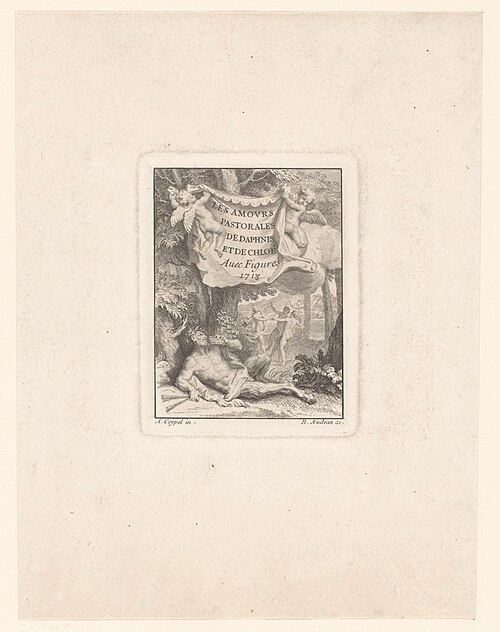
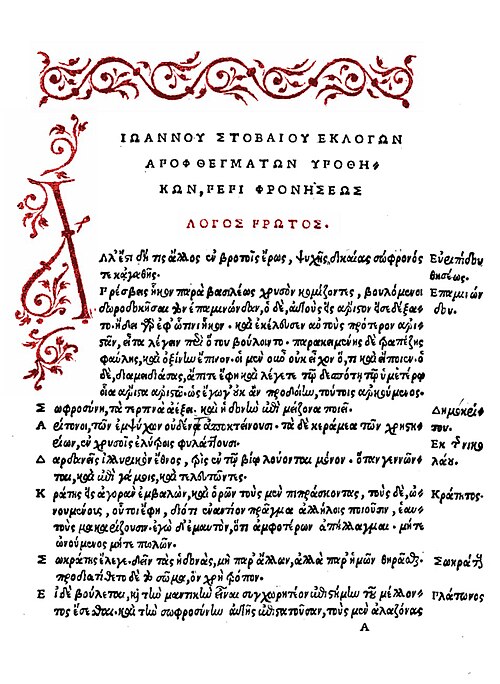
Public-domain pictures from Wikimedia Commons.
A line to remember
Ἡροδότου Ἁλικαρνησσέος ἱστορίης ἀπόδεξις ἥδε, ὡς μήτε τὰ γενόμενα ἐξ ἀνθρώπων τῷ χρόνῳ ἐξίτηλα γένηται, μήτε ἔργα μεγάλα τε καὶ θωμαστά, τὰ μὲν Ἕλλησι τὰ δὲ βαρβάροισι ἀποδεχθέντα, ἀκλεᾶ γένηται.
In today's GreekΑυτή είναι η έκθεση της έρευνας του Ηροδότου από την Αλικαρνασσό, για να μη σβήσουν με τον χρόνο όσα έκαναν οι άνθρωποι, και για να μη μείνουν χωρίς δόξα έργα μεγάλα και θαυμαστά, άλλα των Ελλήνων και άλλα των βαρβάρων.
Irodotou Alikarnisseos istoriis apodexis ide, os mite ta genomena ex anthropon to chrono exitila genitai, mite erga megala te kai thomasta, ta men Ellisi ta de varvaroisi apodechthenta, aklea genitai.
This is the setting-out of the inquiry of Herodotus of Halicarnassus, so that what people have done may not fade with time, and that great and marvellous deeds, some performed by Greeks and some by barbarians, may not go without glory.
From the original
The text as Herodotus wrote it, out of copyright, with our own translation beside it.
«Ἱστορίαι»The Histories
The opening of the Histories: Herodotus names himself and his purpose, then turns straight to the question of who started the conflict between Greeks and Persians, beginning with the Persian version of the story.
Ἱστορίαι, Book 1 (Κλειώ), the proem and the start of 1.1 (c. 430 BC) · Public-domain text, source: el.wikisource.org