grecfacilegrecfacile
Euclid
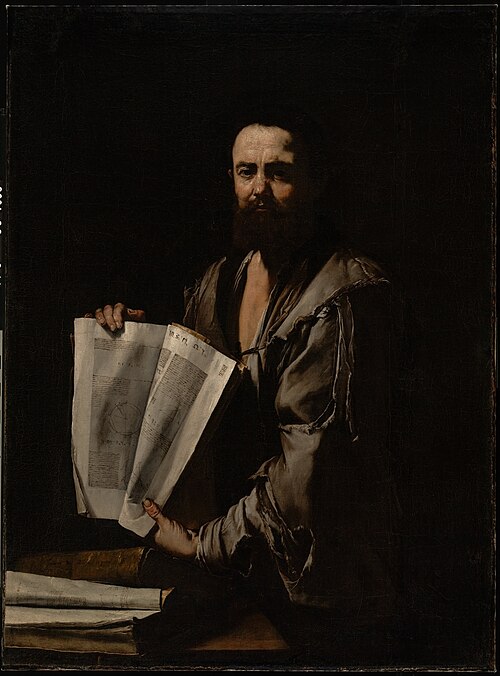
Jusepe de Ribera · Public domain · Wikimedia Commons

C1Antiquity · Mathematician

Euclid

Ευκλείδης

c. 325 BC – c. 265 BC · Alexandria

Euclid (Ευκλείδης, active around 300 BC) taught mathematics in Alexandria under Ptolemy I and wrote the Στοιχεία (Elements), thirteen books that start from a handful of definitions and five postulates and build up, proof by proof, the whole geometry of the plane and of space and a good part of number theory. For more than two thousand years it was the textbook of mathematics and the model of what a proof is; few books have been printed more often.

Life

Of Euclid's life almost nothing is known, not even where he was born. The main witness is Proclus, a philosopher writing in Athens around AD 450, who says that Euclid lived in the time of Ptolemy I, the general of Alexander who ruled Egypt from 323 BC, that he was younger than the pupils of Plato and older than Eratosthenes and Archimedes, and that he gathered the work of earlier geometers into the Elements. From this his working life is placed around 300 BC, in Alexandria, the new capital where Ptolemy was founding the Museum and the Library. He probably studied in Athens with Plato's successors, and Pappus, writing in the fourth century AD, describes him as gentle and modest towards anyone who could advance mathematics.

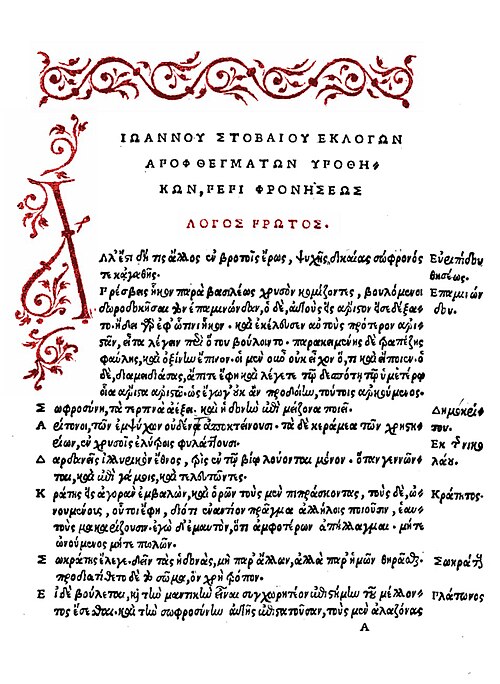
Two anecdotes stand in for a biography. Proclus tells that Ptolemy asked Euclid whether there was a shorter way to learn geometry than the Elements, and Euclid answered that there is no royal road to geometry. Stobaeus tells that a young man who had just learned his first theorem asked what he would gain from it, and Euclid told his slave to give the boy a coin, since he had to make a profit from what he learned. The dates given for his birth and death, around 325 and 265 BC, are guesses.

He should not be confused with Euclid of Megara, a pupil of Socrates who lived a century earlier; medieval and Renaissance editions printed the philosopher's name and biography on the mathematician's book for hundreds of years.

Works

The Στοιχεία (Elements) are thirteen books, and their method is their fame. Book I opens with twenty-three definitions («A point is that which has no part»), five postulates (a straight line can be drawn between any two points; all right angles are equal; and the famous fifth, on parallels) and five common notions (things equal to the same thing are equal to each other). From these alone, every proposition is proved from what came before, each ending with the words ὅπερ ἔδει δεῖξαι, «which was to be shown», the Latin QED. Book I ends with Pythagoras's theorem. Books II–VI treat areas, circles, polygons and proportion; Books VII–IX are number theory, with the Euclidean algorithm for the greatest common divisor and the proof, in IX.20, that there are infinitely many prime numbers; Book X is a long study of irrational quantities; Books XI–XIII are solid geometry, ending with the construction of the five regular solids.

Little of the mathematics was Euclid's own discovery; his achievement was the order. He also wrote the Δεδομένα (Data), on what follows from given quantities, the Ὀπτικά (Optics), the first geometrical treatment of perspective, the Φαινόμενα on the geometry of the heavens, and lost works on conics and porisms. The Elements were translated into Arabic in the ninth century and from Arabic into Latin in the twelfth, printed for the first time in Venice in 1482, and taught, often unchanged, until the twentieth century. The fifth postulate, which seemed less obvious than the others, was attacked for two millennia until Lobachevsky and Bolyai, in the 1820s and 1830s, showed that denying it gives consistent non-Euclidean geometries, the mathematics Einstein would later need.

Legacy in Greece today

In Greek lyceums the geometry course is still called Ευκλείδεια Γεωμετρία, and pupils prove theorems in Euclid's order, with the same words: υπόθεση, απόδειξη, όπερ έδει δείξαι. The Hellenic Mathematical Society publishes its magazines for pupils under the name Ευκλείδης and names a round of its national competition after him. There is an Ευκλείδου street in central Athens and in most Greek towns. Beyond Greece, the European Space Agency's telescope launched in 2023 to map the geometry of the universe is called Euclid, and a crater on the Moon bears his name. A learner who wants to read the first page of the Elements in the original will find the Greek of the definitions short, concrete and, with a little help, readable.

Did you know?

  • Asked by King Ptolemy for a quicker way to learn geometry, he is said to have answered that there is no royal road to geometry.
  • For centuries his book carried the life story of the wrong man, Euclid of Megara, a philosopher who lived a hundred years earlier.
  • The Elements were first printed in Venice in 1482, with the diagrams in the margins, and have been reissued in more than a thousand editions since.
  • Abraham Lincoln said he had mastered the first six books of Euclid in order to learn what it means to demonstrate something.

Key works

Greek titleTitleYear
ΣτοιχείαElements (13 books)c. 300 BC
ΔεδομέναDatac. 300 BC
ΟπτικάOpticsc. 300 BC
ΦαινόμεναPhaenomena (spherical astronomy)c. 300 BC
Κατατομή κανόνοςDivision of the Scale (on musical intervals, attributed)c. 300 BC

A line to remember

Σημεῖόν ἐστιν, οὗ μέρος οὐθέν. Γραμμὴ δὲ μῆκος ἀπλατές.

In today's GreekΣημείο είναι αυτό που δεν έχει μέρη. Γραμμή είναι μήκος χωρίς πλάτος.

Simeion estin, ou meros outhen. Grammi de mikos aplates.

A point is that which has no part. A line is length without breadth.

Στοιχεία (Elements), Book I, definitions 1 and 2

From the original

The text as Euclid wrote it, out of copyright, with our own translation beside it.

«Στοιχεῖα»Elements

The opening of Book I of the Elements: the first seven definitions and the five postulates on which the whole of Euclid's geometry is built. The fifth, the parallel postulate, was debated for two thousand years until non-Euclidean geometry was discovered.

α΄. Σημεῖόν ἐστιν, οὗ μέρος οὐθέν. β΄. Γραμμὴ δὲ μῆκος ἀπλατές. γ΄. Γραμμῆς δὲ πέρατα σημεῖα. δ΄. Εὐθεῖα γραμμή ἐστιν, ἥτις ἐξ ἴσου τοῖς ἐφ' ἑαυτῆς σημείοις κεῖται. ε΄. Ἐπιφάνεια δέ ἐστιν, ὃ μῆκος καὶ πλάτος μόνον ἔχει. ϛ΄. Ἐπιφανείας δὲ πέρατα γραμμαί. ζ΄. Ἐπίπεδος ἐπιφάνειά ἐστιν, ἥτις ἐξ ἴσου ταῖς ἐφ' ἑαυτῆς εὐθείαις κεῖται.1. A point is that which has no part. 2. A line is length without breadth. 3. The ends of a line are points. 4. A straight line is one that lies equally with respect to the points on it. 5. A surface is that which has length and breadth only. 6. The ends of a surface are lines. 7. A plane surface is one that lies equally with respect to the straight lines on it.
α΄. Ἠιτήσθω ἀπὸ παντὸς σημείου ἐπὶ πᾶν σημεῖον εὐθεῖαν γραμμὴν ἀγαγεῖν. β΄. Καὶ πεπερασμένην εὐθεῖαν κατὰ τὸ συνεχὲς ἐπ' εὐθείας ἐκβαλεῖν. γ΄. Καὶ παντὶ κέντρῳ καὶ διαστήματι κύκλον γράφεσθαι. δ΄. Καὶ πάσας τὰς ὀρθὰς γωνίας ἴσας ἀλλήλαις εἶναι. ε΄. Καὶ ἐὰν εἰς δύο εὐθείας εὐθεῖα ἐμπίπτουσα τὰς ἐντὸς καὶ ἐπὶ τὰ αὐτὰ μέρη γωνίας δύο ὀρθῶν ἐλάσσονας ποιῇ, ἐκβαλλομένας τὰς δύο εὐθείας ἐπ' ἄπειρον συμπίπτειν, ἐφ' ἃ μέρη εἰσὶν αἱ τῶν δύο ὀρθῶν ἐλάσσονες.1. Let it be postulated that a straight line can be drawn from any point to any point. 2. And that a finite straight line can be extended continuously in a straight line. 3. And that a circle can be drawn with any centre and any radius. 4. And that all right angles are equal to one another. 5. And that if a straight line falling on two straight lines makes the interior angles on the same side less than two right angles, the two straight lines, if extended indefinitely, meet on the side where the angles are less than two right angles.

Στοιχεῖα, Book I: Definitions 1–7 and Postulates 1–5 (c. 300 BC) · Public-domain text, source: el.wikisource.org
C1

Read about Euclid in Greek (C1)

Words from the passage

  • definition
  • notion, concept
  • strict, rigorous
  • I prove
  • proof
  • theorem
  • infinite
  • model, standard

Test yourself: 4 words from this page

1 / 4

What does this word mean?

Want to learn Greek?Start learning Greek
Others at level C1

Modern Greece · Novelist and short-story writerAlexandros Papadiamantis1851 – 1911Antiquity · Lyric poetSapphoc. 630 BC – c. 570 BCAntiquity · TragedianAeschylusc. 525 BC – 456 BCAntiquity · HistorianHerodotusc. 484 BC – c. 425 BCRenaissance · Poet (Cretan Renaissance)Vitsentzos Kornaros1553 – 1613 or 1614Antiquity · PhilosopherSocratesc. 470 BC – 399 BCAntiquity · PhilosopherEpicurus341 BC – 270 BCAntiquity · Orator and statesmanDemosthenes384 BC – 322 BCRenaissance · HymnographerRomanos the Melodistc. 490 – c. 556Modern Greece · General of 1821, memoiristIoannis Makriyannis1797 – 1864Modern Greece · PoetNapoleon Lapathiotis1888 – 1944Modern Greece · NovelistKonstantinos Theotokis1872 – 1923Modern Greece · Film directorTheo Angelopoulos1935 – 2012Modern Greece · Poet, satiristKostas Varnalis1884 – 1974Modern Greece · Theatre directorKarolos Koun1908 – 1987Modern Greece · Poet, novelistKonstantinos Chatzopoulos1868 – 1920Modern Greece · NovelistM. Karagatsis1908 – 1960Modern Greece · Novelist, playwrightAngelos Terzakis1907 – 1979Modern Greece · PoetManolis Anagnostakis1925 – 2005Modern Greece · NovelistKostas Taktsis1927 – 1988Modern Greece · Scholar, EnlightenmentEvgenios Voulgaris1716 – 1806Modern Greece · Artist (Arte Povera)Jannis Kounellis1936 – 2017Modern Greece · SculptorChryssa (Vardea)1933 – 2013Modern Greece · ComposerNikos Skalkottas1904 – 1949Modern Greece · ComposerManolis Kalomiris1883 – 1962Modern Greece · Journalist, feministKallirroi Parren1861 – 1940Modern Greece · Poet, actressKaterina Gogou1940 – 1993Modern Greece · FolkloristNikolaos Politis1852 – 1921Modern Greece · ArchitectDimitris Pikionis1887 – 1968Modern Greece · ComposerThanos Mikroutsikos1947 – 2019Modern Greece · Playwright, journalistSpyros Melas1882 – 1966Modern Greece · NovelistAlkyoni PapadakiModern Greece · Theatre historian · translation scholarAnna TabakiModern Greece · ChoreographerAndonis Foniadakis1971Modern Greece · Singer-songwriter · painterArleta1945 – 2017Modern Greece · Stage and screen actressBetty Arvaniti1939Modern Greece · Island folk singerEleni Legaki1956Modern Greece · Singer · rebetiko and laïkoFoteini Velesiotou1958Modern Greece · Choreographer · dancerIoannis Mandafounis1981Modern Greece · Poet · translator · editorKaterina Iliopoulou1967Modern Greece · Stage actressKyveli1888 – 1978Modern Greece · Singer · lyricistLizeta Kalimeri1969Antiquity · Ancient novelistLongusModern Greece · SingerLoukas GiorkasModern Greece · Painter and printmakerLoukia Maggiorou1914 – 2008Antiquity · Speechwriter and oratorLysiasc. 445 BC – c. 380 BCModern Greece · SingerMarika Papagika1890 – 1943Modern Greece · Tenor · crossover singerMario Frangoulis1966Modern Greece · Singer · composer · music educatorMariza Koch1944Modern Greece · Singer · songwriterMatoula Zamani1981Modern Greece · Poet · translatorMelissanthi1907 – 1990Antiquity · Bronze sculptorMyronModern Greece · Painter and tapestry artistNiki Kanagini1933 – 2008Modern Greece · Laïko singerNikos Vertis1976Modern Greece · Stage actress · translatorNonika Galinea1938 – 2023Antiquity · Poet · EpigrammatistNossisModern Greece · RapperPavlos Fyssas1979 – 2013Modern Greece · Singer · songwriterPenny BaltatziAntiquity · PhilosopherPlotinusc. AD 204–205 – 270Modern Greece · ChoreographerSofia Mavragani1978Modern Greece · Theatre and opera directorSpyros Evangelatos1940 – 2017Antiquity · AnthologistStobaeusAntiquity · Elegiac poetTyrtaeus7th c. BCModern Greece · Singer · songwriterVictor Vernicos2006Modern Greece · Poet · prose writerVictoria Theodorouc. 1925 – 2019Modern Greece · Hellenist and scholarJacqueline de Romilly1913 – 2010

All personalities →