grecfacilegrecfacile
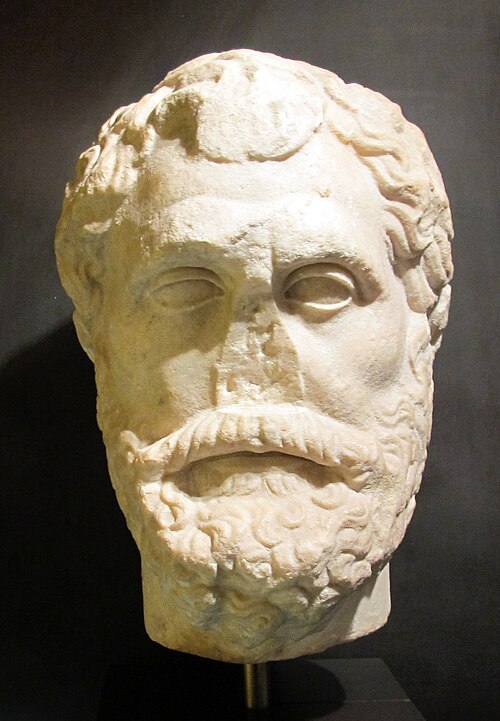
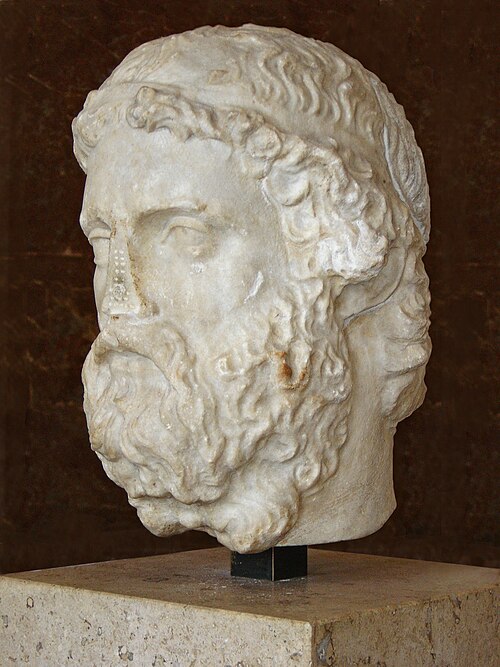
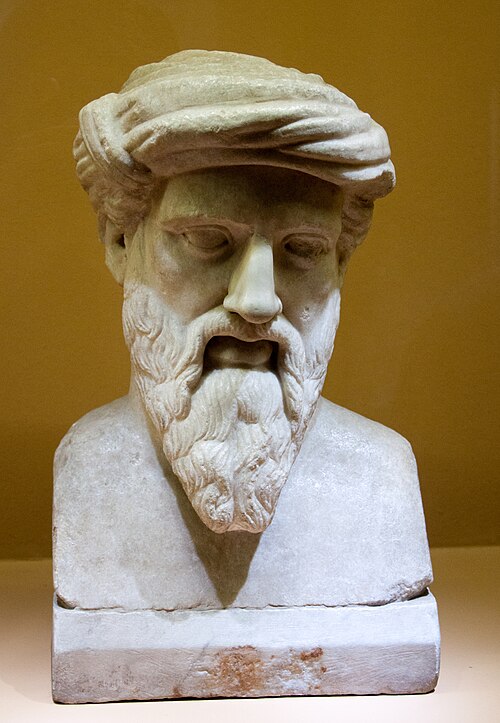
Pythagoras
Unknown author · Public domain · Wikimedia Commons

A2Antiquity · Philosopher and mathematician

Pythagoras

Πυθαγόρας

c. 570 BC – c. 495 BC · Samos; Croton (southern Italy)

Pythagoras (Πυθαγόρας, c. 570–c. 495 BC), born on the island of Samos, is the name behind the theorem about right-angled triangles that every schoolchild learns. He was much more than a mathematician: around 530 BC he settled in Croton in southern Italy and founded a community that lived by strict rules, believed that the soul is reborn in new bodies and taught that numbers are the key to the whole universe. He wrote nothing; the legend did the rest.

Life

Pythagoras was born on Samos, the large island off the coast of Asia Minor, around 570 BC, the son of Mnesarchus, a gem-engraver or merchant. Later writers say he travelled widely in his youth and studied with the priests of Egypt and the astronomers of Babylon; the stories are late, but Samos in his time was a rich trading island with contacts across the eastern Mediterranean, so some of it may be true. Around 530 BC, while the tyrant Polycrates ruled Samos, he left the island for good and sailed west to Croton (Κρότων), a Greek city on the sole of Italy.

In Croton he founded something between a philosophical school, a religious brotherhood and a political club. Members shared property, followed rules of silence and diet, and were divided into inner and outer circles; unusually for the age, women were admitted, and tradition names Theano, his wife, among the Pythagoreans. The community gained great influence over Croton and neighbouring cities, and that influence made enemies. A revolt led by a Crotoniate named Cylon drove the Pythagoreans out and burned their meeting house. Pythagoras withdrew to Metapontum, further along the coast, where he died around 495 BC.

Everything we know comes from others, and most of it from much later: Aristotle speaks cautiously of «the so-called Pythagoreans», while the biographies by Porphyry and Iamblichus, written eight centuries after his death, make him a miracle-worker with a golden thigh. Already in his lifetime he was famous: his contemporary Xenophanes mocks him for stopping a man beating a puppy because he recognised in its yelp the voice of a dead friend.

Works

The heart of Pythagorean teaching was that the world is built on number. The followers discovered that the pleasant musical intervals correspond to simple ratios of string lengths: the octave is 2:1, the fifth 3:2, the fourth 4:3. If harmony is number, they reasoned, perhaps everything is, from the movements of the planets, which they imagined producing a music of the spheres, to justice and the soul. They revered the τετρακτύς, the triangle of ten dots made of 1+2+3+4, and swore oaths by it. The theorem that carries his name, that in a right-angled triangle the square on the hypotenuse equals the sum of the squares on the other two sides, was known in practice to the Babylonians a thousand years earlier; what the Pythagoreans probably added was the idea of proving it.

The second pillar was the soul. Pythagoras taught μετεμψύχωση, the passage of the soul after death into another body, human or animal, which is why his followers would not eat meat and treated animals with care. The famous ban on eating beans belongs to the same body of rules, the ἀκούσματα (things heard), short sayings that members learned and obeyed without question; the phrase «αὐτὸς ἔφα», he himself said it, was their final argument. According to a tradition going back to the fourth century BC, Pythagoras also coined the word φιλόσοφος, lover of wisdom, saying that only the gods are wise. His school lived on for generations: Philolaus wrote down its cosmology, Archytas of Tarentum built machines and governed his city, and Plato absorbed Pythagorean ideas about number and the immortal soul into his own philosophy.

Legacy in Greece today

Every Greek pupil learns the Πυθαγόρειο θεώρημα in the second year of gymnasium, usually in the formula «το τετράγωνο της υποτείνουσας ισούται με το άθροισμα των τετραγώνων των δύο κάθετων πλευρών», and it stays with people for life. On Samos the harbour town of Tigani was renamed Πυθαγόρειο (Pythagoreio) in 1955; a tall statue of Pythagoras holding a right angle stands at the end of its harbour mole, and the ancient town, with the tunnel of Eupalinos from his own century, is a UNESCO World Heritage site. In every souvenir shop on the island you can buy the «δίκαιη κούπα του Πυθαγόρα» (Pythagorean cup), which empties itself completely if you fill it too greedily: a lesson in moderation the ancients attributed to him. The Greek word for a vegetarian used to be «πυθαγόρειος», and musicians still speak of the Pythagorean tuning.

Did you know?

  • The theorem named after him was used by Babylonian surveyors more than a thousand years before he was born; his school's contribution was probably the proof.
  • Tradition says he was the first to call himself a φιλόσοφος, a lover of wisdom, rather than a σοφός, a wise man.
  • His followers were not allowed to eat beans, and several ancient writers offer competing explanations why.
  • Not a single sentence written by Pythagoras survives; even the ancients disagreed about whether he had written anything at all.

Key works

Greek titleTitleYear
Η πυθαγόρεια κοινότητα του ΚρότωναThe Pythagorean community at Crotonc. 530 BC
Η μετεμψύχωσηThe doctrine of the transmigration of souls
Οι μουσικές αναλογίες (2:1, 3:2, 4:3)The musical ratios of the octave, fifth and fourth
«Τα πάντα είναι αριθμός»«All things are number»
Το Πυθαγόρειο θεώρημαThe Pythagorean theorem
Χρυσά ΈπηThe Golden Verses (attributed to his school)Hellenistic period

A line to remember

Μηδ’ ὕπνον μαλακοῖσιν ἐπ’ ὄμμασι προσδέξασθαι, / πρὶν τῶν ἡμερινῶν ἔργων τρὶς ἕκαστον ἐπελθεῖν· / πῇ παρέβην; τί δ’ ἔρεξα; τί μοι δέον οὐκ ἐτελέσθη;

In today's GreekΜη δεχτείς τον ύπνο στα απαλά σου μάτια, / πριν περάσεις τρεις φορές από τον νου σου κάθε πράξη της ημέρας: / πού έσφαλα; τι έκανα; τι χρέος μου έμεινε ανεκπλήρωτο;

Mid’ ypnon malakoisin ep’ ommasi prosdexasthai, / prin ton imerinon ergon tris ekaston epelthein: / pi parevin? ti d’ erexa? ti moi deon ouk etelesthi?

Do not let sleep onto your soft eyes / before you have gone three times over each deed of the day: / where did I go wrong? what did I do? what duty did I leave undone?

Χρυσά Έπη (Golden Verses), 40–42, attributed to the Pythagorean school

From the original

The text as Pythagoras wrote it, out of copyright, with our own translation beside it.

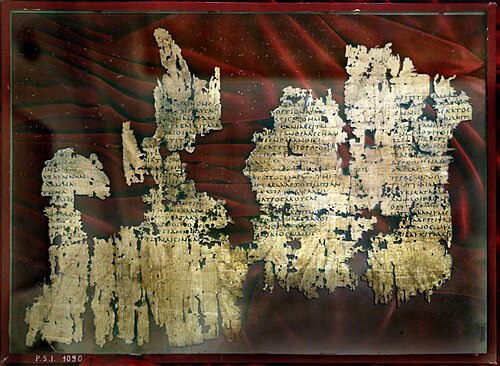
«Πυθαγόρου βίος (Πορφύριος)»Life of Pythagoras (Porphyry)

Pythagoras left no writings; this is Porphyry's Life reporting his rule of the day. The two sets of verses the disciple recites at night and on waking, including the lines quoted on this page, are the ones later gathered into the school's Golden Verses.

ἡδονὴν δὲ οὐ προσίετο τὴν δημώδη καὶ γοητευτικήν, ἀλλὰ τὴν βέβαιον καὶ σεμνοτάτην καὶ καθαρεύουσαν διαβολῆς. διττὴν γὰρ εἶναι διαφορὰν ἡδονῶν· τὴν μὲν γὰρ γαστρὶ καὶ ἀφροδισίοις διὰ πολυτελείας κεχαρισμένην ἀπείκαζε ταῖς ἀνδροφόνοις τῶν σειρήνων ᾠδαῖς· τὴν δ' ἐπὶ καλοῖς καὶ δικαίοις τοῖς πρὸς τὸ ζῆν ἀναγκαίοις, ὁμοίως καὶ παραχρῆμα ἡδεῖαν καὶ εἰς τὸ ἐπιὸν ἀμεταμέλητον, ἣν ἔφασκεν ἐοικέναι μουσῶν τινὶ ἁρμονίᾳ. δύο δὲ μάλιστα καιροὺς παρηγγύα ἐν φροντίδι θέσθαι, τὸν μὲν ὅτε εἰς ὕπνον τρέποιτο, τὸν δ' ὅτε ἐξ ὕπνου διανίσταιτο. ἐπισκοπεῖν γὰρ προσήκειν ἐν ἑκατέρῳ τούτοιν τά τε ἤδη πεπραγμένα καὶ τὰ μέλλοντα, τῶν μὲν γενομένων εὐθύνας παρ' ἑαυτοῦ ἕκαστον λαμβάνοντα, τῶν δὲ μελλόντων πρόνοιαν ποιούμενον. πρὸ μὲν οὖν τοῦ ὕπνου ταῦτα ἑαυτῷ τὰ ἔπη ἐπᾴδειν ἕκαστον· μηδ' ὕπνον μαλακοῖσιν ἐπ' ὄμμασι προσδέξασθαι πρὶν τῶν ἡμερινῶν ἔργων τρὶς ἕκαστον ἐπελθεῖν, πῇ παρέβην; τί δ' ἔρεξα; τί μοι δέον οὐκ ἐτελέσθη; πρὸ δὲ τῆς ἐξαναστάσεως ἐκεῖνα· πρῶτα μὲν ἐξ ὕπνοιο μελίφρονος ἐξυπαναστὰς εὖ μάλ' ὀπιπεύειν ὅσ' ἐν ἤματι ἔργα τελέσσεις. τοιαῦτα παρῄνει· μάλιστα δ' ἀληθεύειν· τοῦτο γὰρ μόνον δύνασθαι τοὺς ἀνθρώπους ποιεῖν θεῷ παραπλησίους.The pleasure he admitted was not the vulgar, beguiling kind but the steady and most dignified kind, the kind free of reproach. For there are, he said, two sorts of pleasure: the one that gratifies the belly and the bed through luxury he likened to the murderous songs of the Sirens; the one founded on what is good and just and necessary for life, as sweet in the moment as it is free of regret afterwards, he said was like a harmony of the Muses. Two moments above all he urged people to take to heart: when one turns to sleep, and when one rises from sleep. For at each of these one should review what has already been done and what is still to be done, calling oneself to account for the past and taking thought for the future. So before sleep each person should recite to himself these verses: Do not let sleep onto your soft eyes before you have gone three times over each deed of the day: where did I go wrong? what did I do? what duty did I leave undone? And before rising, these: First, as soon as you rise from honey-sweet sleep, look carefully over the deeds you will accomplish in the day. Such was his counsel; and above all, to speak the truth, for this alone, he said, can make human beings like god.

Πορφύριος, Πυθαγόρου βίος 39–40 (3rd c. AD), reporting Pythagoras’ precepts and quoting the Golden Verses · Public-domain text, source: el.wikisource.org
A2

Read about Pythagoras in Greek (A2)

Words from the passage

  • island
  • city, town
  • school (of thought)
  • pupil, disciple
  • meat
  • number
  • I explain
  • statue

Test yourself: 4 words from this page

1 / 4

What does this word mean?

Want to learn Greek?Start learning Greek
Others at level A2

Modern Greece · PoetKonstantinos Kavafis1863 – 1933Modern Greece · PoetYannis Ritsos1909 – 1990Modern Greece · Novelist (children's literature)Penelope Delta1874 – 1941Antiquity · Epic poetHomerc. 8th century BCModern Greece · NovelistNikos Kazantzakis1883 – 1957Antiquity · Cynic philosopherDiogenes the Cynicc. 412 BC – 323 BCAntiquity · Philosopher and mathematicianThales of Miletusc. 624 BC – c. 546 BCRenaissance · PainterEl Greco1541 – 1614Modern Greece · PainterNikolaos Gyzis1842 – 1901Modern Greece · SopranoMaria Callas1923 – 1977Modern Greece · ComposerManos Hadjidakis1925 – 1994Modern Greece · ActorThanasis Veggos1927 – 2011Modern Greece · PoetGeorgios Drosinis1859 – 1951Modern Greece · PoetNikiforos Vrettakos1912 – 1991Modern Greece · Singer, lyra playerNikos Xylouris1936 – 1980Modern Greece · PhysicianGeorgios Papanikolaou1883 – 1962Modern Greece · Priest and fighter of 1821Papaflessasc. 1788 – 1825Modern Greece · Satirical poetGeorgios Souris1853 – 1919Modern Greece · SculptorYannoulis Chalepas1851 – 1938Modern Greece · PainterAlekos Fassianos1935 – 2022Modern Greece · ComposerSpyridon Samaras1861 – 1917Modern Greece · Rebetiko singerSotiria Bellou1921 – 1997Modern Greece · Rebetiko singerMarika Ninou1922 – 1957Modern Greece · Bouzouki virtuoso, composerManolis Chiotis1921 – 1970Modern Greece · ActressKatina Paxinou1900 – 1973Modern Greece · Rebetiko singerRosa Eskenazic. 1895 – 1980Modern Greece · ActorManos Katrakis1908 – 1984Modern Greece · PainterDimitris Mytaras1934 – 2017Modern Greece · ComposerManos Loizos1937 – 1982Modern Greece · Laïko singerDimitris Mitropanos1948 – 2012Modern Greece · General of 1821Odysseas Androutsosc. 1790 – 1825Modern Greece · Leader of the Filiki EtaireiaAlexandros Ypsilantis1792 – 1828Modern Greece · PhotographerNelly's (Elli Souyioultzoglou-Seraidari)1899 – 1998Modern Greece · Mezzo-sopranoAgnes Baltsa1944Modern Greece · Lied singer and benefactorAlexandra Trianti1896/1901 – 1977Modern Greece · Actor · DirectorAlekos Alexandrakis1928 – 2005Antiquity · Lyric poetAlcaeus of MytileneModern Greece · SingerAlkistis Protopsalti1954Modern Greece · Singer · songwriterAmanda TenfjordAntiquity · Lyric poetAnacreonc. 570 BCE – c. 485 BCEModern Greece · Novelist and journalistAndreas Frangias1921 – 2002Modern Greece · Singer · songwriterAndromacheModern Greece · SingerAnna Vissi1957Modern Greece · Poet · EditorAntonis Fostieris1953Antiquity · Poet · EpigrammatistAnyte of TegeaAntiquity · Epic poet · ScholarApollonius of RhodesAntiquity · Archaic lyric poetArchilochusModern Greece · NovelistChristos Chomenidis1966Modern Greece · Short-story writerChristos Ikonomou1970Modern Greece · Singer · musical performerDemy1991Modern Greece · SingerDespina Vandi1969Modern Greece · Singer · composerDimitra Galani1952Modern Greece · Playwright · TranslatorDimitris Dimitriadis1944Modern Greece · Singer-songwriterDionysis Savvopoulos1944 – 2025Modern Greece · Singer · popular song and poetryEleftheria Arvanitaki1957Modern Greece · SingerEleftheria Eleftheriou1989Modern Greece · Pop singerElena Tsagrinou1994Modern Greece · SingerEleni Foureira1987Modern Greece · Singer · Greek song and international repertoireElli Paspala1957Modern Greece · Novelist · PuppeteerEvgenia Fakinou1945Modern Greece · Singer · SongwriterGianna Terzi1980Modern Greece · Basketball playerGiannis Antetokounmpo1994Modern Greece · Composer · ConductorGiannis Markopoulos1939 – 2023Modern Greece · Classical pianistGina Bachauer1910 – 1976Modern Greece · Singer · guitaristGeorge Dalaras1949Modern Greece · SculptorGiorgos Zongolopoulos1903 – 2004Modern Greece · SingerGlykeria1953Modern Greece · Singer · songwriterHaris Alexiou1950Modern Greece · Pop singerHelena Paparizou1982Modern Greece · Poet and librettistIoulita IliopoulouAntiquity · PoetErinnaModern Greece · SingerIvi Adamou1993Modern Greece · Pop · laïko singerKaiti Garbi1961Modern Greece · Singer · songwriterKaterine Duska1989Modern Greece · Poet and travel writerKostas Ouranis1890 – 1953Modern Greece · Composer · pianistLena Platonos1951Modern Greece · Singer · songwriterMaria Elena Kyriakou1984Modern Greece · Tennis playerMaria Sakkari1995Modern Greece · Singer · producerMarina Satti1986Modern Greece · SingerMarinella1938 – 2026Modern Greece · NovelistMaro Douka1947Modern Greece · Singer · contemporary Greek songMelina Kana1966Modern Greece · Poet and lyricistMichalis Ganas1944 – 2024Modern Greece · Composer · PianistMimis Plessas1924 – 2024Modern Greece · SingerNatassa Bofiliou1983Modern Greece · Actor · screenwriterNia Vardalos1962Modern Greece · Writer and essayistNikos Dimou1935Modern Greece · PainterNikos Nikolaou1909 – 1986Modern Greece · Singer-songwriter · ProducerNikos Papazoglou1948 – 2011Modern Greece · Poet and illustratorPavlina Pampoudi1948Modern Greece · Pianist and composerRena Kyriakou1917 – 1994Modern Greece · Singer · dancerSilia Kapsis2006Modern Greece · Singer-songwriter · GuitaristSokratis Malamas1957Modern Greece · Composer · SongwriterStavros Kougioumtzis1932 – 2005Modern Greece · Composer and conductorStavros Xarchakos1939Modern Greece · SingerTamta1981Modern Greece · Soprano · Opera and filmTeresa Stratas1938Modern Greece · Painter · visual chroniclerThalia Flora-Karavia1871 – 1960Modern Greece · Songwriter · SingerThanasis Papakonstantinou1959Antiquity · Bucolic poetTheocritusModern Greece · SingerVicky Leandros1952Modern Greece · Composer · keyboardistYanni1954

All personalities →