grecfacilegrecfacile
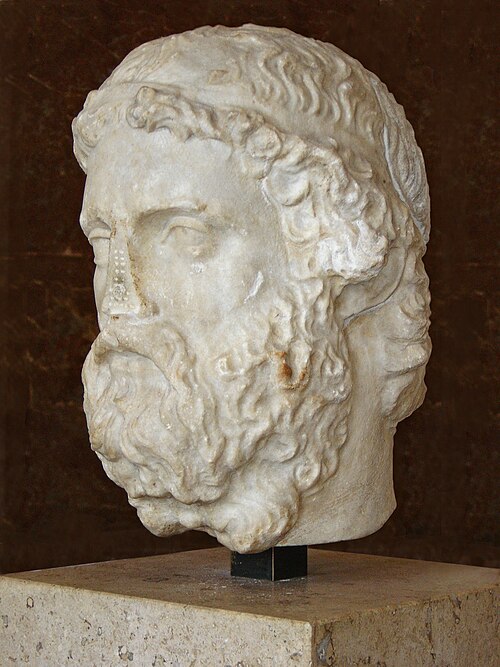
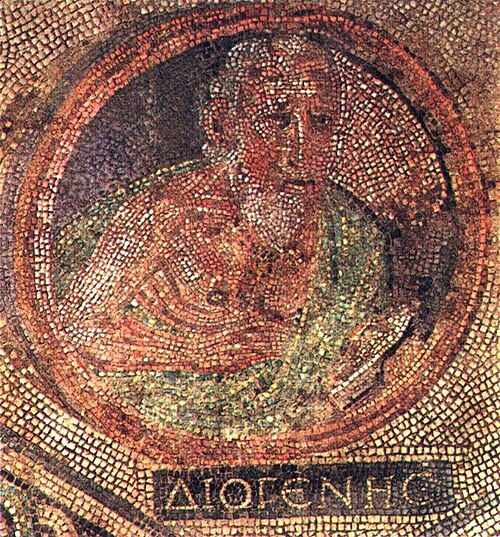
Diogenes the Cynic
Unknown author · Public domain · Wikimedia Commons

A2Antiquity · Cynic philosopher

Diogenes the Cynic

Διογένης ο Κυνικός

c. 412 BC – 323 BC · Sinope; Athens; Corinth

Diogenes, Διογένης (Diogenis) in Greek, was born in Sinope on the Black Sea around 412 BC and died in Corinth in 323 BC. He lived in Athens in a large clay jar, owned almost nothing, and made his life a public lesson that people need far less than they think. The stories about him, the lamp in daylight, the meeting with Alexander the Great, the thrown-away cup, are the best-known anecdotes in Greek philosophy.

Life

Almost everything we know about Diogenes comes from the sixth book of Diogenes Laertius, written some five centuries later and full of anecdotes rather than dates. He was born in Sinope, a Greek colony on the Black Sea coast of today's Turkey, around 412 BC. His father Hicesias was involved with the city's mint, and father and son were accused of «defacing the currency», which is why Diogenes left Sinope in exile. He turned the charge into a motto: his life's work would be to «deface the currency» of custom and convention.

In Athens he attached himself to the philosopher Antisthenes, a pupil of Socrates, and took the simple life further than anyone before him. He wore one rough cloak, carried a staff and a bag, slept in a large storage jar (a πίθος, pithos) by the temple of the Mother of the Gods in the Agora, and ate, washed and did everything else in public. He begged, he argued, and he insulted the famous. Plato, the story goes, called him «a Socrates gone mad».

Later, on a sea voyage, he was captured by pirates and sold as a slave in Crete to a Corinthian named Xeniades, whose sons he educated. He spent his last years in Corinth, where he met Alexander, and died there in 323 BC, very old, according to tradition on the same day as Alexander himself. The Corinthians set a marble dog on a pillar over his grave.

Works

Diogenes wrote nothing that survives, though Diogenes Laertius lists dialogues and even a «Republic» under his name. His work is his life, and it comes to us as stories. Asked why he walked through Athens in broad daylight holding a lit lamp, he answered «Άνθρωπον ζητώ» (I am looking for a human being), a line Greeks still quote. Seeing a child drink water from his hands, he threw away his wooden cup, saying a child had beaten him in simplicity. When Plato defined man as «a featherless two-legged animal», Diogenes plucked a chicken, brought it into the school and announced: «Here is Plato's man».

The most famous story is the meeting at Corinth, around 336 BC. Alexander, the young king of Macedon, came to see the celebrated philosopher, found him sunning himself and asked whether he could do anything for him. Diogenes replied: «Stand a little out of my sun». Alexander's companions laughed, but the king said that if he were not Alexander he would choose to be Diogenes.

Behind the jokes is a serious idea. Happiness, Diogenes taught, comes from living according to nature with as few needs as possible, free from the fear of poverty, shame or public opinion. He called himself a κοσμοπολίτης, a citizen of the world, when asked where he came from, which is the first recorded use of the word. Because he and his followers lived «like dogs» (κύνες, kynes) they were called Cynics, and his example led, through his pupil Crates, to the Stoic school and to a long tradition of plain-living philosophers.

Legacy in Greece today

Diogenes is a stock figure of Greek culture: the man in the jar is proverbial, and «Άνθρωπον ζητώ» is still said, half in jest, when someone searches in vain for an honest person. The Modern Greek word κυνικός (cynical) and the international word cynic both come from his school, though their meaning has drifted. The meeting with Alexander is read in every Greek school, in the Ancient Greek anthology of the gymnasium, and Alexander's reply has become a byword for admiration. In Sinop, the modern Turkish town on the site of Sinope, a statue of Diogenes with his lamp and dog stands by the harbour, and the lamp and jar appear in paintings from Jean-Léon Gérôme to Greek cartoons. Doctors even speak of «Diogenes syndrome» for extreme self-neglect, a label the philosopher, who chose his poverty freely, would have found unfair.

Did you know?

  • He is the first person recorded as calling himself a «citizen of the world» (κοσμοπολίτης).
  • According to tradition he died on the same day in 323 BC as Alexander the Great, the king he had told to get out of his sunlight.
  • When asked what wine he liked best, he reportedly answered «other people's».
  • His grave at Corinth was marked with a dog on a column, the animal that gave the Cynics their name.

Key works

Greek titleTitleYear
Το πιθάρι στην Αγορά της ΑθήναςThe jar in the Athenian Agorac. 380s BC
«Άνθρωπον ζητώ»: το λυχνάρι μέρα μεσημέρι«I am looking for a human being»: the lamp in daylight
Ο κοσμοπολίτηςThe citizen of the world
Η συνάντηση με τον Αλέξανδρο στην ΚόρινθοThe meeting with Alexander at Corinthc. 336 BC
Πολιτεία (χαμένη)Republic (lost)

A line to remember

Μικρὸν ἀπὸ τοῦ ἡλίου μετάστηθι.

In today's GreekΚάνε λίγο πιο πέρα, μου κρύβεις τον ήλιο.

Mikron apo tou iliou metastithi.

Stand a little out of my sun.
Diogenes Laertius, Lives of the Philosophers 6.38, to Alexander the Great at Corinth
A2

Read about Diogenes the Cynic in Greek (A2)

Words from the passage

  • philosopher
  • large clay jar
  • cup, glass
  • hand
  • I walk
  • oil lamp
  • I look for
  • I hide

Test yourself: 4 words from this page

1 / 4

What does this word mean?

Want to learn Greek?Start learning Greek

Others at level A2

Modern Greece · PoetKonstantinos Kavafis1863 – 1933Modern Greece · PoetYannis Ritsos1909 – 1990Modern Greece · Novelist (children's literature)Penelope Delta1874 – 1941Antiquity · Epic poetHomerc. 8th century BCModern Greece · NovelistNikos Kazantzakis1883 – 1957Antiquity · Philosopher and mathematicianThales of Miletusc. 624 BC – c. 546 BCAntiquity · Philosopher and mathematicianPythagorasc. 570 BC – c. 495 BCRenaissance · PainterEl Greco1541 – 1614Modern Greece · PainterNikolaos Gyzis1842 – 1901Modern Greece · SopranoMaria Callas1923 – 1977Modern Greece · ComposerManos Hadjidakis1925 – 1994Modern Greece · ActorThanasis Veggos1927 – 2011Modern Greece · PoetGeorgios Drosinis1859 – 1951Modern Greece · PoetNikiforos Vrettakos1912 – 1991Modern Greece · Singer, lyra playerNikos Xylouris1936 – 1980Modern Greece · PhysicianGeorgios Papanikolaou1883 – 1962Modern Greece · Priest and fighter of 1821Papaflessasc. 1788 – 1825Modern Greece · Satirical poetGeorgios Souris1853 – 1919Modern Greece · SculptorYannoulis Chalepas1851 – 1938Modern Greece · PainterAlekos Fassianos1935 – 2022Modern Greece · ComposerSpyridon Samaras1861 – 1917Modern Greece · Rebetiko singerSotiria Bellou1921 – 1997Modern Greece · Rebetiko singerMarika Ninou1922 – 1957Modern Greece · Bouzouki virtuoso, composerManolis Chiotis1921 – 1970Modern Greece · ActressKatina Paxinou1900 – 1973Modern Greece · Rebetiko singerRosa Eskenazic. 1895 – 1980Modern Greece · ActorManos Katrakis1908 – 1984Modern Greece · PainterDimitris Mytaras1934 – 2017Modern Greece · ComposerManos Loizos1937 – 1982Modern Greece · Laïko singerDimitris Mitropanos1948 – 2012Modern Greece · General of 1821Odysseas Androutsosc. 1790 – 1825Modern Greece · Leader of the Filiki EtaireiaAlexandros Ypsilantis1792 – 1828Modern Greece · PhotographerNelly's (Elli Souyioultzoglou-Seraidari)1899 – 1998Modern Greece · Mezzo-sopranoAgnes Baltsa1944Modern Greece · Lied singer and benefactorAlexandra Trianti1896/1901 – 1977Modern Greece · Actor · DirectorAlekos Alexandrakis1928 – 2005Antiquity · Lyric poetAlcaeus of MytileneModern Greece · SingerAlkistis Protopsalti1954Modern Greece · Singer · songwriterAmanda TenfjordAntiquity · Lyric poetAnacreonc. 570 BCE – c. 485 BCEModern Greece · Novelist and journalistAndreas Frangias1921 – 2002Modern Greece · Singer · songwriterAndromacheModern Greece · SingerAnna Vissi1957Modern Greece · Poet · EditorAntonis Fostieris1953Antiquity · Poet · EpigrammatistAnyte of TegeaAntiquity · Epic poet · ScholarApollonius of RhodesAntiquity · Archaic lyric poetArchilochusModern Greece · NovelistChristos Chomenidis1966Modern Greece · Short-story writerChristos Ikonomou1970Modern Greece · Singer · musical performerDemy1991Modern Greece · SingerDespina Vandi1969Modern Greece · Singer · composerDimitra Galani1952Modern Greece · Playwright · TranslatorDimitris Dimitriadis1944Modern Greece · Singer-songwriterDionysis Savvopoulos1944 – 2025Modern Greece · Singer · popular song and poetryEleftheria Arvanitaki1957Modern Greece · SingerEleftheria Eleftheriou1989Modern Greece · Pop singerElena Tsagrinou1994Modern Greece · SingerEleni Foureira1987Modern Greece · Singer · Greek song and international repertoireElli Paspala1957Modern Greece · Novelist · PuppeteerEvgenia Fakinou1945Modern Greece · Singer · SongwriterGianna Terzi1980Modern Greece · Basketball playerGiannis Antetokounmpo1994Modern Greece · Composer · ConductorGiannis Markopoulos1939 – 2023Modern Greece · Classical pianistGina Bachauer1910 – 1976Modern Greece · Singer · guitaristGeorge Dalaras1949Modern Greece · SculptorGiorgos Zongolopoulos1903 – 2004Modern Greece · SingerGlykeria1953Modern Greece · Singer · songwriterHaris Alexiou1950Modern Greece · Pop singerHelena Paparizou1982Modern Greece · Poet and librettistIoulita IliopoulouAntiquity · PoetErinnaModern Greece · SingerIvi Adamou1993Modern Greece · Pop · laïko singerKaiti Garbi1961Modern Greece · Singer · songwriterKaterine Duska1989Modern Greece · Poet and travel writerKostas Ouranis1890 – 1953Modern Greece · Composer · pianistLena Platonos1951Modern Greece · Singer · songwriterMaria Elena Kyriakou1984Modern Greece · Tennis playerMaria Sakkari1995Modern Greece · Singer · producerMarina Satti1986Modern Greece · SingerMarinella1938 – 2026Modern Greece · NovelistMaro Douka1947Modern Greece · Singer · contemporary Greek songMelina Kana1966Modern Greece · Poet and lyricistMichalis Ganas1944 – 2024Modern Greece · Composer · PianistMimis Plessas1924 – 2024Modern Greece · SingerNatassa Bofiliou1983Modern Greece · Actor · screenwriterNia Vardalos1962Modern Greece · Writer and essayistNikos Dimou1935Modern Greece · PainterNikos Nikolaou1909 – 1986Modern Greece · Singer-songwriter · ProducerNikos Papazoglou1948 – 2011Modern Greece · Poet and illustratorPavlina Pampoudi1948Modern Greece · Pianist and composerRena Kyriakou1917 – 1994Modern Greece · Singer · dancerSilia Kapsis2006Modern Greece · Singer-songwriter · GuitaristSokratis Malamas1957Modern Greece · Composer · SongwriterStavros Kougioumtzis1932 – 2005Modern Greece · Composer and conductorStavros Xarchakos1939Modern Greece · SingerTamta1981Modern Greece · Soprano · Opera and filmTeresa Stratas1938Modern Greece · Painter · visual chroniclerThalia Flora-Karavia1871 – 1960Modern Greece · Songwriter · SingerThanasis Papakonstantinou1959Antiquity · Bucolic poetTheocritusModern Greece · SingerVicky Leandros1952Modern Greece · Composer · keyboardistYanni1954
All personalities →