Life
Alexander was born in Pella, the capital of Macedon, in the summer of 356 BC, the son of King Philip II and Olympias, a princess from Epirus. Philip was turning Macedon into the strongest state in Greece, and he gave his son the best teacher available: from about 343 BC the philosopher Aristotle taught the boy at Mieza, near Pella. Plutarch tells how the young Alexander tamed the horse Βουκεφάλας (Bucephalus), which no one else could ride, by noticing that it was frightened of its own shadow and turning it to face the sun.
In 336 BC Philip was murdered at Aigai, today's Vergina, and Alexander became king at twenty. After securing Greece, he crossed the Hellespont into Asia in 334 BC with an army of about 40,000 men. Three battles broke the Persian king Darius III: the Granicus in 334, Issus in 333 and Gaugamela in 331. In between he cut the Gordian knot, was welcomed in Egypt and founded Alexandria there in 331. Babylon, Susa and Persepolis followed, then Central Asia, and in 326 BC he crossed the Indus and defeated King Porus at the river Hydaspes, where Bucephalus died. At the Hyphasis his exhausted soldiers refused to go further, and he turned back through the deserts of Gedrosia.
He died in Babylon in June 323 BC, after a sudden fever, not yet thirty-three. He had reigned less than thirteen years and had never lost a battle. His generals divided the empire between them, and his tomb in Alexandria, visited by Roman emperors, was later lost and has never been found.
Works

Alexander wrote nothing; his «works» are what he did, and they are known from Arrian, Plutarch, Diodorus and Curtius, who used the lost memoirs of his companions. The Granicus (334 BC) opened Asia Minor; Issus (333 BC) put Darius to flight and gave Alexander the Persian king's family and treasure; Gaugamela (331 BC), on the plain near Arbela in today's Iraq, destroyed the Persian army and made him master of the empire. The Hydaspes (326 BC), fought in monsoon rain against war elephants, was his last great battle.
Just as important is what he built. He founded some twenty cities called Alexandria, from Egypt to Afghanistan, settling Greeks and Macedonians in them; the Egyptian Alexandria, with its lighthouse and library, became the largest Greek city in the world. Greek became the language of administration and trade from the Nile to the Indus, and the simplified common Greek that spread with it, the Κοινή (Koine), is the Greek of the New Testament. The period that followed his death, with Greek kingdoms in Egypt, Syria and Macedon and Greek art and science flourishing in Alexandria, Pergamon and Antioch, is called Hellenistic because of him.
He was also a figure of myth already in his lifetime: he visited the oracle of Ammon in the Egyptian desert, was greeted as a son of Zeus, and adopted some Persian court customs, which many of his Macedonians resented. The ancient «Alexander Romance» later turned him into a hero of fairy tales, flying in a basket carried by eagles and diving to the bottom of the sea.
Legacy in Greece today
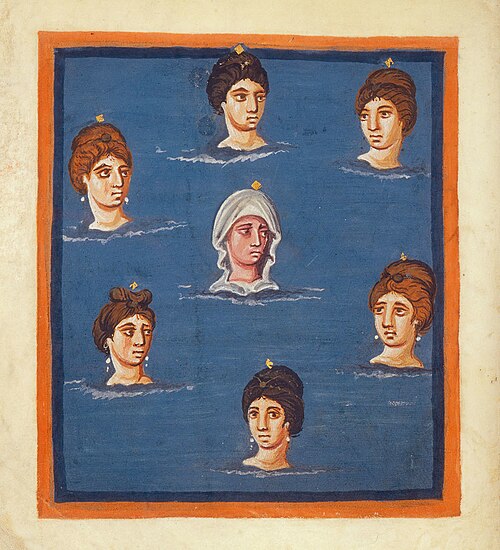
In Greece Alexander is everywhere. Almost every town has a street named Μεγάλου Αλεξάνδρου, the airport of Kavala carries his name, and the large bronze statue of him on Bucephalus on the Thessaloniki waterfront is a meeting point for the whole city. The royal tombs at Vergina, where Manolis Andronikos found the unlooted tomb of Philip II in 1977, and the archaeological site and museum at Pella, with its pebble mosaics, are the two places to visit. The sixteen-rayed Vergina Sun from Philip's tomb has become a Macedonian symbol. In folk legend his sister, the Gorgona, a mermaid, stops ships to ask «Ζει ο βασιλιάς Αλέξανδρος;» (Is King Alexander alive?), and the sailors must answer «Ζει και βασιλεύει και τον κόσμο κυριεύει» (He lives and reigns and rules the world), or the ship is lost. The shadow-theatre hero Karagiozis fights the cursed snake as Alexander, and Αλέξανδρος remains one of the most common Greek first names.
Did you know?
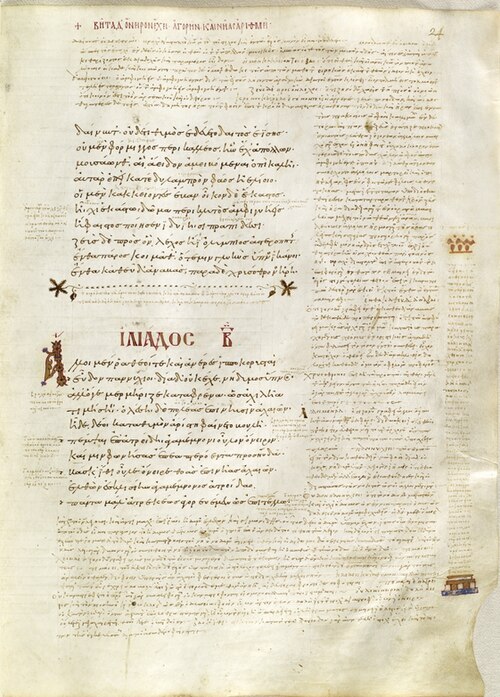
- Plutarch says he slept with a copy of the Iliad, annotated by Aristotle, under his pillow next to a dagger.
- He named a city, Bucephala, after his horse, on the river Hydaspes in today's Pakistan.
- At Gordion in 333 BC he dealt with the famous knot that no one could untie, according to the best-known version, by cutting it with his sword.
- When he met the philosopher Diogenes, who asked him only to step out of his sunlight, he is said to have remarked that if he were not Alexander he would like to be Diogenes.
Key works
| Greek title | Title | Year |
|---|---|---|
| Μάχη του Γρανικού | Battle of the Granicus | 334 BC |
| Μάχη της Ισσού | Battle of Issus | 333 BC |
| Ίδρυση της Αλεξάνδρειας | Foundation of Alexandria | 331 BC |
| Μάχη των Γαυγαμήλων | Battle of Gaugamela | 331 BC |
| Μάχη του Υδάσπη | Battle of the Hydaspes | 326 BC |
From the works


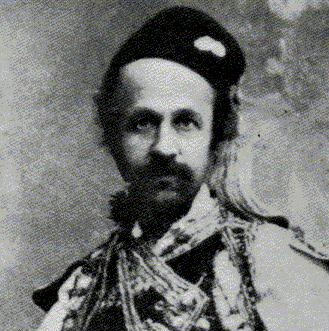
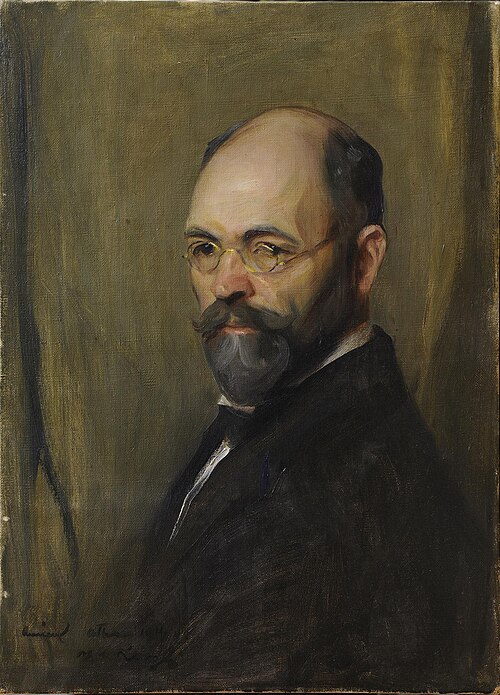
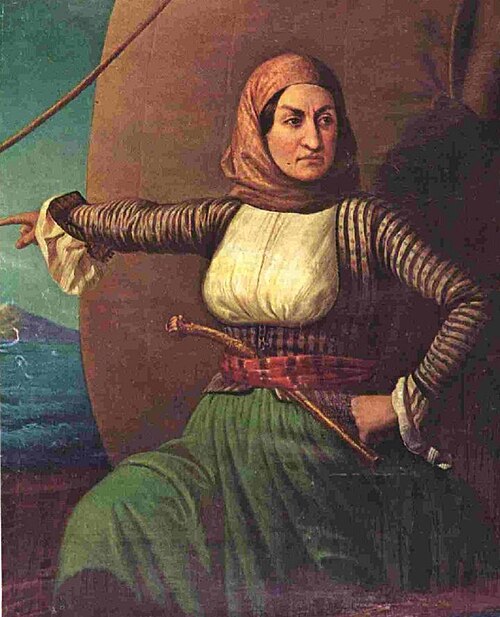
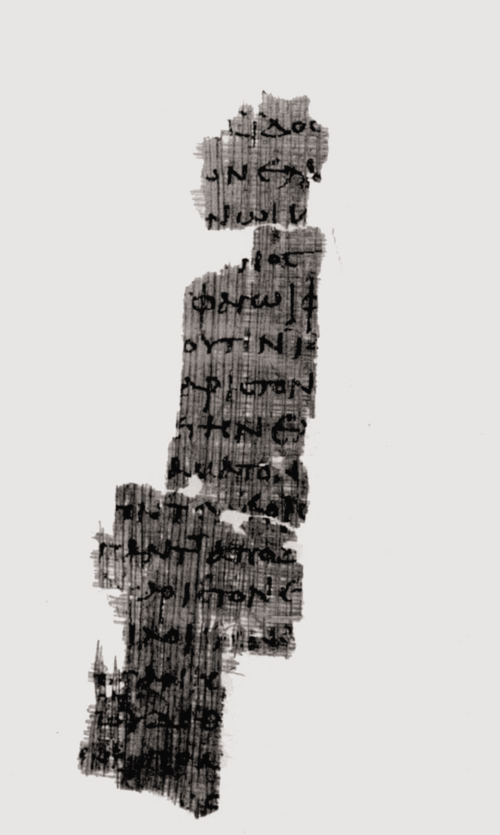
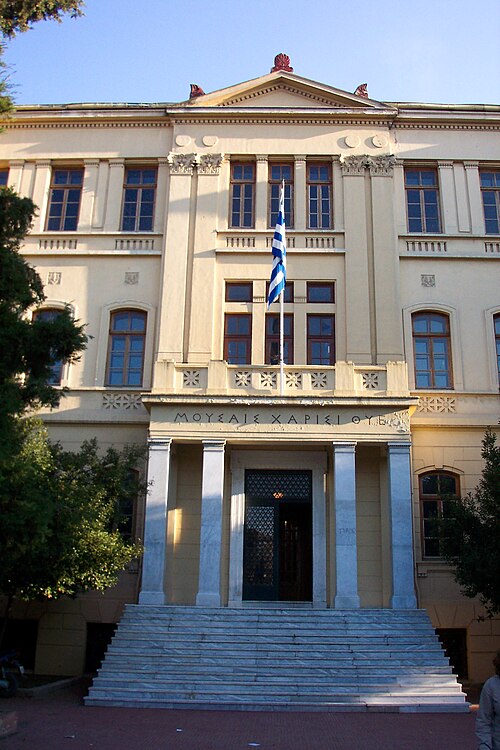
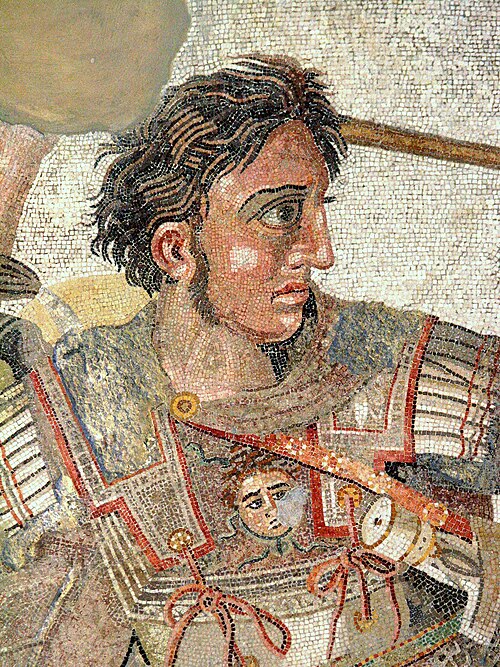
Public-domain pictures from Wikimedia Commons.
A line to remember
Εἰ μὴ Ἀλέξανδρος ἤμην, Διογένης ἂν ἤμην.
In today's GreekΑν δεν ήμουν ο Αλέξανδρος, θα ήθελα να είμαι ο Διογένης.
Ei mi Alexandros imin, Diogenis an imin.
If I were not Alexander, I would be Diogenes.