grecfacilegrecfacile
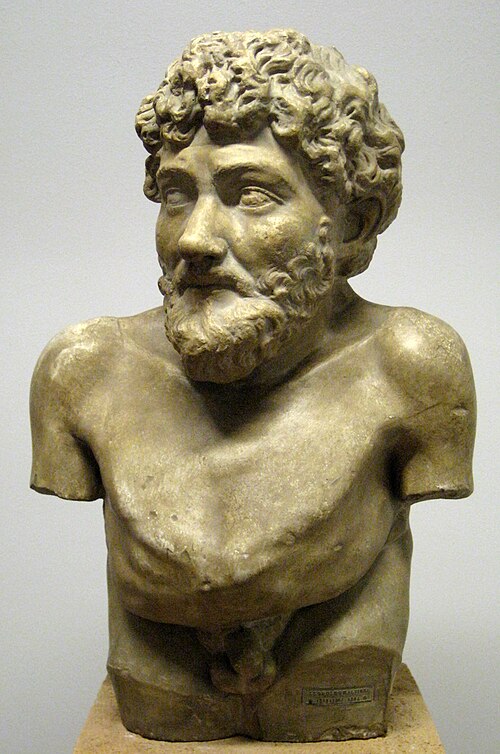
Aesop
shakko · CC BY-SA 3.0 · Wikimedia Commons

A1Antiquity · Fabulist

Aesop

Αίσωπος

c. 620 BC – c. 564 BC · Samos (by tradition); Thrace or Phrygia

Aesop, Αίσωπος (Aisopos) in Greek, is the name behind the fables: tiny stories in which a fox, a lion, an ant or a tortoise behaves exactly like a human being, and the ending teaches a lesson. He is said to have lived in the sixth century BC, an enslaved man who won his freedom with his wit. Whether or not he existed quite as the legend tells it, the fables that carry his name have been told in Greek for some 2,500 years.

Life

Almost everything about Aesop's life comes from stories told long after his death. The earliest mention is in Herodotus, writing in the fifth century BC: he says Aesop was a slave on the island of Samos, owned by a man called Iadmon, and that he was killed by the people of Delphi, who later paid compensation for his death. Later writers add that he came from Thrace or Phrygia, that he was freed because of his cleverness, and that he travelled to the courts of kings, settling quarrels with a well-chosen story. The traditional dates, around 620 to 564 BC, are no more than a best guess.

In the first centuries AD an anonymous Greek text, the Βίος Αισώπου (Life of Aesop), turned him into a folk hero: ugly, hunch-backed and at first unable to speak, until a goddess gave him the gift of language, after which he outwitted his philosopher master at every turn. The Delphi episode became a tragic ending: accused of stealing a sacred cup, he was thrown from a cliff.

Historians treat all of this with caution. What is certain is that by the fifth century BC the Athenians already spoke of Aesop's stories as something familiar: Aristophanes jokes about them in his comedies, and Plato records that Socrates, waiting in prison for his execution, passed the time turning Aesop's fables into verse.

Works

A fable (μύθος, mythos) is a very short story, usually with animals as characters, that ends in a moral, and Aesop's are the model for the whole genre. In Η αλεπού και τα σταφύλια (The Fox and the Grapes) a fox cannot reach a bunch of grapes and walks away saying they were sour anyway. In Ο λαγός και η χελώνα (The Hare and the Tortoise) the slow, steady tortoise wins the race. In Ο τζίτζικας και ο μέρμηγκας (The Cicada and the Ant) the cicada who sang all summer begs the hard-working ant for food when winter comes. Others everyone knows: the shepherd boy who cried wolf, the lion and the mouse, the town mouse and the country mouse, the wolf and the lamb.

Aesop wrote nothing down. The fables circulated by word of mouth for centuries before Demetrius of Phalerum collected them around 300 BC; that collection is lost, and the versions we read come from later authors, Phaedrus in Latin verse in the first century AD, Babrius in Greek verse around the second century, and anonymous Greek prose collections. The ancient prose is plain and quick: a situation, a twist, and the closing formula ὁ μῦθος δηλοῖ (the fable shows that…), followed by the lesson. That lean structure is exactly why the fables have survived every change of language and taste, and why they are among the easiest ancient Greek texts to read.

Legacy in Greece today

In Greece the fables are the first literature a child meets: they appear in primary-school readers and in countless picture books, and Αισώπειος μύθος (an Aesopian fable) is the standard term for any story with a moral. Several fables live on as everyday expressions. When someone pretends not to want what they cannot have, Greeks say «ξινά τα σταφύλια» (sour grapes), straight from the fox. The ancient closing formula «ο μύθος δηλοί» is used with a smile to announce the moral of any story, and someone who gives false alarms «φωνάζει λύκος» (cries wolf). A learner can start with the Greek versions of The Fox and the Grapes or The Hare and the Tortoise: short, present-tense, full of animal words, and already familiar from childhood in almost any language.

Did you know?

  • Herodotus names Aesop as a fellow slave of Rhodopis, a famous courtesan, in the household of Iadmon on Samos, which is the oldest surviving reference to him.
  • According to Plato's Phaedo, Socrates spent his last days in prison putting Aesop's fables into verse.
  • Not a single line survives from Aesop's own time; the oldest complete collections are Phaedrus in Latin and Babrius in Greek, written five to seven centuries after he supposedly lived.
  • The English expression «sour grapes» and the Greek «ξινά τα σταφύλια» come from the same fable about a fox.

Key works

Greek titleTitleYear
Η αλεπού και τα σταφύλιαThe Fox and the Grapes
Ο λαγός και η χελώναThe Hare and the Tortoise
Ο τζίτζικας και ο μέρμηγκαςThe Cicada and the Ant
Ο βοσκός που φώναζε «λύκος»The Boy Who Cried Wolf
Το λιοντάρι και το ποντίκιThe Lion and the Mouse
Αισώπειοι μύθοι (συλλογή)Aesop's Fables (the collected fables)collected c. 300 BC onward

A line to remember

Ἀπαλλαττομένη δὲ πρὸς ἑαυτὴν εἶπεν· «Ὄμφακές εἰσιν.»

In today's GreekΦεύγοντας, είπε μέσα της: «Είναι άγουρα.»

Apallattomeni de pros eaftin eipen: «Omfakes eisin.»

As she walked away she said to herself: «They are unripe.»

Αλώπηξ και βότρυς (The Fox and the Grapes), Aesopic collection

From the original

The text as Aesop wrote it, out of copyright, with our own translation beside it.

«Κόραξ καὶ ἀλώπηξ»The Crow and the Fox

A complete fable with its moral. The fox and the grapes, quoted above, is only a few lines long; here the same sly fox wins by flattery instead of losing.

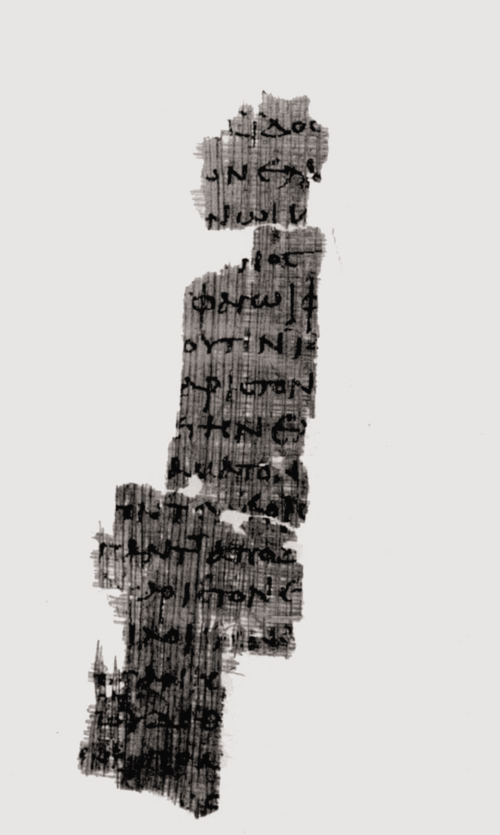
Κόραξ κρέας ἁρπάσας ἐπί τινος δένδρου ἐκάθισεν. Ἀλώπηξ δὲ θεασαμένη αὐτὸν καὶ βουλομένη τοῦ κρέατος περιγενέσθαι στᾶσα ἐπῄνει αὐτον ὡς εὐμεγέθη τε καὶ καλόν, λέγουσα καὶ ὡς πρέπει αὐτῷ μάλιστα τῶν ὀρνέων βασιλεύειν, καὶ τοῦτο πάντως ἂν ἐγένετο, εἰ φωνὴν εἶχεν. Ὁ δὲ παραστῆσαι αὐτῇ θέλων ὅτι καὶ φωνὴν ἔχει, ἀποβαλὼν τὸ κρέας μεγάλα ἐκεκράγει. Ἐκείνη δὲ προσδραμοῦσα καὶ τὸ κρέας ἁρπάσασα ἔφη· «Ὦ κόραξ, καὶ φρένας εἰ εἶχες, οὐδὲν ἂν ἐδέησας εἰς τὸ πάντων σε βασιλεῦσαι.»A crow snatched a piece of meat and settled on a tree. A fox saw him and, wanting to get the meat for herself, stood below and praised him for being so big and handsome, adding that of all the birds he was the one best suited to be king, and that this would surely have come about if only he had a voice. The crow, wanting to show her that he had a voice too, dropped the meat and cawed loudly. The fox ran up, snatched the meat and said: «Crow, if you had brains as well, you would lack nothing to be king of all.»
Πρὸς ἄνδρα ἀνόητον ὁ λόγος εὔκαιρος.The story is fitting for a foolish man.

Κόραξ καὶ ἀλώπηξ (The Crow and the Fox), complete, Aesopic collection (Chambry edition) · Public-domain text, source: el.wikisource.org
A1

Read about Aesop in Greek (A1)

Words from the passage

  • writer
  • old
  • island
  • story
  • fable, myth
  • fox
  • lesson
  • I read

Test yourself: 4 words from this page

1 / 4

What does this word mean?

Want to learn Greek?Start learning Greek
Others at level A1

Modern Greece · PoetDionysios Solomos1798 – 1857Modern Greece · PoetOdysseas Elytis1911 – 1996Modern Greece · Poet and lyricistNikos Gatsos1911 – 1992Modern Greece · Novelist (children's and young-adult literature)Alki Zei1923 – 2020Antiquity · King of SpartaLeonidas of Spartac. 540 BC – 480 BCModern Greece · Marathon runnerSpyridon Louis1873 – 1940Modern Greece · PainterNikiforos Lytras1832 – 1904Modern Greece · Folk painterTheophilos Hatzimihailc. 1870 – 1934Modern Greece · PainterGeorgios Jakobides1853 – 1932Antiquity · King and conquerorAlexander the Great356 BC – 323 BCModern Greece · Naval commander of 1821Laskarina Bouboulina1771 – 1825Modern Greece · Actress, singer, politicianMelina Mercouri1920 – 1994Modern Greece · ComposerMikis Theodorakis1925 – 2021Modern Greece · ActressAliki Vougiouklaki1934 – 1996Modern Greece · Children's authorEugene Trivizas1946Modern Greece · SingerNana Mouskouri1934Modern Greece · General of 1821Georgios Karaiskakis1782 – 1827Modern Greece · Souliot captain of 1821Markos Botsarisc. 1788 – 1823Modern Greece · Hero of 1821Athanasios Diakosc. 1788 – 1821Modern Greece · Admiral, fireship captainKonstantinos Kanarisc. 1790 – 1877Modern Greece · Heroine of 1821Manto Mavrogenous1796 – 1848Modern Greece · Laïko singerStelios Kazantzidis1931 – 2001Modern Greece · Singer, bouzouki playerGrigoris Bithikotsis1922 – 2005Modern Greece · SingerDemis Roussos1946 – 2015Modern Greece · Bouzouki player, composerGiorgos Zambetas1925 – 1992Modern Greece · ActressIrene Papas1926 – 2022Modern Greece · Comic actorVasilis Logothetidis1898 – 1960Modern Greece · Comic actorDinos Iliopoulos1913 – 2001Modern Greece · ActressElli Lambeti1926 – 1983Modern Greece · ActorDimitris Horn1921 – 1998Modern Greece · Painter of the seaKonstantinos Volanakis1837 – 1907Modern Greece · Actress and singerRena Vlachopoulou1923 – 2004Modern Greece · ActressJenny Karezi1932 – 1992Modern Greece · Rebetiko singer · musicianAgathonas Iakovidis1955 – 2020Modern Greece · SingerAnastasia Moutsatsou1961Modern Greece · Byzantine historianAngeliki Laiou1941 – 2008Antiquity · Didactic poetAratusc. 315/310 BC – c. 240 BCModern Greece · Actor · filmmakerAriane Labed1984Antiquity · Homeric scholar and editorAristarchus of Samothracec. 216 BC – c. 144 BCModern Greece · Singer · songwriter · translatorDanai Stratigopoulou1913 – 2009Modern Greece · Printmaker · visual artistDimitra Siaterli1952Modern Greece · Film directorDimitris Stavrakas1938Modern Greece · SingerEleni DimouModern Greece · SingerEleni Tsaligopoulou1963Antiquity · Vase painter and potterExekiasModern Greece · Cinematographer · film directorPhedon Papamichael1962Modern Greece · Singer · lyra playerGeorgia DagakiModern Greece · NovelistIsmini Kapandai1939Antiquity · Lyric poetIbycusModern Greece · Film and stage directorJules Dassin1911 – 2008Modern Greece · Pop singerKlavdiac. 2002Modern Greece · Writer and theatre directorLena Kitsopoulou1971Modern Greece · Novelist · journalistLili Zografou1922 – 1998Modern Greece · Historian · bibliographerLoukia Droulia1931 – 2019Modern Greece · Film and stage actressMary Chronopoulou1933 – 2023Modern Greece · Actor and dancerMaria NafpliotouModern Greece · Singer · actorMarianna PolychronidiModern Greece · Singer · songwriterMonika1985Modern Greece · Singer and composerNena Venetsanou1955Modern Greece · Actor · directorOlia LazaridouModern Greece · Film directorPantelis Voulgaris1940Modern Greece · ChoreographerPatricia ApergiModern Greece · Theatre director · actressRoula PaterakiModern Greece · Singer · performerSakis Rouvas1972Modern Greece · Singer · revue actressSofia Vembo1910 – 1978Modern Greece · Film and stage actressThemis Bazaka1957Antiquity · Elegiac poetTheognis of Megara6th c. BCModern Greece · Poet · playwright · essayistZoe Karelli1901 – 1998

All personalities →