grecfacilegrecfacile
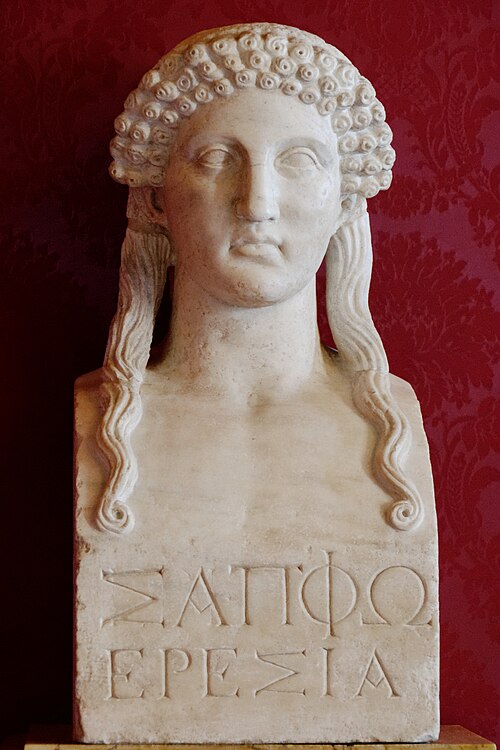
Sappho
Marie-Lan Nguyen · Public domain · Wikimedia Commons

C1Antiquity · Lyric poet

Sappho

Σαπφώ

c. 630 BC – c. 570 BC · Eresos and Mytilene, Lesbos

Sappho (Σαπφώ) lived on the island of Lesbos around 600 BC and wrote songs to be sung to the lyre: about love, jealousy, weddings, her daughter, the moon. Antiquity called her 'the tenth Muse'; of perhaps 10,000 lines, only one complete poem and several hundred fragments survive. Yet two and a half thousand years later she is still the voice everyone quotes when love strikes 'like a wind falling on oaks'.

Life

Almost everything we know about Sappho's life comes from her own fragments and from much later, unreliable writers. She was born around 630 BC on Lesbos, either at Eresos in the west of the island or at Mytilene, its chief city, into an aristocratic family. The poems mention a daughter, Kleis, and three brothers, among them Charaxos, a merchant trading in Egypt whom she scolds in the so-called Brothers Poem, and Larichos, a young cupbearer.

Lesbos around 600 BC was torn by struggles between noble families, and Sappho's family ended up on the losing side: an ancient chronicle records that she spent some years in exile in Sicily, probably at Syracuse, before returning home. On Lesbos she seems to have led a circle of young women who sang, learned music and prepared for marriage; many poems are addressed to them by name: Anactoria, Atthis, Gongyla.

The famous story that she threw herself from the white cliff of Leucas for love of a ferryman called Phaon is a comic-stage invention of later centuries, and the date of her death is unknown; a late fragment, the Tithonus poem published in 2004, shows her complaining that her knees no longer carry her to the dance, so she lived at least into old age.

Works

Sappho wrote in the Aeolic dialect of Lesbos, which sounds different from the Attic Greek of the classics: σελάννα for the moon, ἔμμεναι for 'to be'. The scholars of Alexandria collected her songs into nine books, arranged by metre. The first book was in the four-line stanza now called the Sapphic stanza, later borrowed by Catullus and Horace in Latin.

Only one poem survives complete, the Ύμνος στην Αφροδίτη (Hymn to Aphrodite, fr. 1), in which the goddess arrives in a chariot drawn by sparrows and asks, amused, who has wronged the poet this time. Fragment 31, Φαίνεταί μοι κῆνος ἴσος θέοισιν (He seems to me equal to the gods), describes the physical symptoms of jealousy: tongue broken, fire under the skin, ears humming, sweat and trembling. Fragment 16 argues that the most beautiful thing on earth is not armies or ships but 'whatever one loves', and proves it with Helen of Troy. Other pieces are wedding songs, a lament for Adonis, a lullaby-like picture of a mother and daughter, and the image of a sweet apple left high on the branch.

Most of this came back to us in the twentieth century from papyrus scraps found in Egypt; the Brothers Poem appeared only in 2014. Her tone is direct, personal and precise, with none of the epic distance of Homer: she says 'I' and means it.

Legacy in Greece today

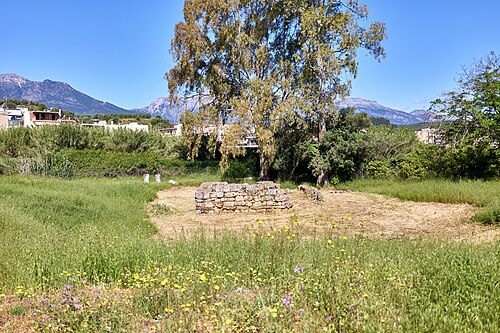
In Mytilene the central square by the harbour is Πλατεία Σαπφούς, with her statue; at Skala Eresou, her presumed birthplace, another statue faces the beach. Odysseas Elytis, himself of Lesbian descent, published a Modern Greek recomposition of her fragments in 1984 (Σαπφώ), the easiest way for a learner to read her. Fragments 1, 16 and 31 appear in Greek school anthologies of ancient lyric poetry, usually with a translation. The words lesbian and sapphic in many languages come from her island and her name. Her verses are quoted at Greek weddings and in songs, and the phrase 'the tenth Muse', from an epigram attributed to Plato, is still how Greeks introduce her.

Did you know?

  • Only one of her poems, the Hymn to Aphrodite, survives from beginning to end; it was copied out by the critic Dionysius of Halicarnassus as a model of smooth style.
  • Two 'new' Sappho poems were published in this century: the Tithonus poem in 2004 and the Brothers Poem in 2014, both from papyri.
  • Fragment 31 was preserved because the treatise On the Sublime quoted it to show how a great poet selects details; Catullus translated it into Latin.
  • In Roman times the city of Mytilene put her portrait on its coins.

Key works

Greek titleTitleYear
Ύμνος στην Αφροδίτη (απ. 1)Hymn to Aphrodite (fr. 1)c. 600 BC
Οἰ μὲν ἰππήων στρότον (απ. 16)Some say an army of horsemen (fr. 16)c. 600 BC
Φαίνεταί μοι κῆνος (απ. 31)He seems to me equal to the gods (fr. 31)c. 600 BC
Ποίημα του ΤιθωνούTithonus poempublished 2004
Ποίημα των ΑδελφώνBrothers Poempublished 2014

A line to remember

οἰ μὲν ἰππήων στρότον οἰ δὲ πέσδων / οἰ δὲ νάων φαῖσ' ἐπὶ γᾶν μέλαιναν / ἔμμεναι κάλλιστον, ἔγω δὲ κῆν' ὄττω τις ἔραται.

In today's GreekΆλλοι λένε πως το πιο όμορφο πράγμα πάνω στη μαύρη γη είναι ένας στρατός από ιππείς, άλλοι από πεζούς, άλλοι καράβια· εγώ όμως λέω πως είναι εκείνο που αγαπά κανείς.

oi men ippion stroton oi de pesdon / oi de naon fais' epi gan melainan / emmenai kalliston, ego de kin' otto tis eratai.

Some say a host of horsemen, some of foot soldiers, / some of ships, is the most beautiful thing on the black earth; / but I say it is whatever one loves.

Απόσπασμα 16 (c. 600 BC)

From the original

The text as Sappho wrote it, out of copyright, with our own translation beside it.

«Απόσπασμα 16»Fragment 16

The poem that holds the quoted lines: Sappho sets armies and fleets against what one loves, takes Helen as her proof, and ends with the absent Anaktoria. The papyrus is torn, so a few lines are lost.

Οἰ μὲν ἰππήων στρότον οἰ δὲ πέσδωνSome say a host of horsemen, some of foot soldiers,
οἰ δὲ νάων φαῖσ᾽ ἐπὶ γᾶν μέλαινανsome a fleet of ships, upon the black earth
ἔμμεναι κάλλιστον, ἔγω δὲ κῆν᾽ ὄτ-is the most beautiful thing; but I say it is whatever
τω τις ἔραται·a person loves.
πάγχυ δ᾽ εὔμαρες σύνετον πόησαιIt is entirely easy to make this clear
πάντι τοῦτ᾽, ἀ γὰρ πόλυ περσκέθοισαto everyone: for she who far surpassed
κάλλος ἀνθρώπων Ἐλένα τὸν ἄνδραall mortals in beauty, Helen, her husband,
τὸν πανάριστονthe best of all men,
καλλίποισ᾽ ἔβα ᾽ς Τροΐαν πλέοισαleft behind and went sailing off to Troy,
κωὐδὲ παῖδος οὐδὲ φίλων τοκήωνand of her child and of her dear parents
πάμπαν ἐμνάσθη, ἀλλὰ παράγαγ᾽ αὔτανshe thought not at all; she was led astray,
τὰν ἀέκοισανagainst her will,
Κύπρις· εὔκαμπτον γὰρ...by Kypris; for easily bent…
...…
κἄμε νῦν Ἀνακτορίας ὀνέμναι-And now she has brought Anaktoria to my mind,
σ᾽ οὐ παρεοίσας,who is not here;
τᾶς κε βολλοίμαν ἔρατόν τε βᾶμαI would rather see her lovely way of walking
κἀμάρυχμα λάμπρον ἴδην προσώπωand the bright glow of her face
ἢ τὰ Λύδων ἄρματα κἀν ὄπλοισιthan the chariots of the Lydians and armoured men
πεσδομάχεντας.fighting on foot.

Fragment 16, lines 1–20 (c. 600 BC), as preserved, with gaps · Public-domain text, source: el.wikisource.org
C1

Read about Sappho in Greek (C1)

Words from the passage

  • lyre
  • dialect
  • jealousy
  • fragment, excerpt
  • antiquity
  • to hum, to buzz
  • exiled
  • invention

Test yourself: 4 words from this page

1 / 4

What does this word mean?

Want to learn Greek?Start learning Greek
Others at level C1

Modern Greece · Novelist and short-story writerAlexandros Papadiamantis1851 – 1911Antiquity · TragedianAeschylusc. 525 BC – 456 BCAntiquity · HistorianHerodotusc. 484 BC – c. 425 BCRenaissance · Poet (Cretan Renaissance)Vitsentzos Kornaros1553 – 1613 or 1614Antiquity · PhilosopherSocratesc. 470 BC – 399 BCAntiquity · PhilosopherEpicurus341 BC – 270 BCAntiquity · Orator and statesmanDemosthenes384 BC – 322 BCRenaissance · HymnographerRomanos the Melodistc. 490 – c. 556Modern Greece · General of 1821, memoiristIoannis Makriyannis1797 – 1864Modern Greece · PoetNapoleon Lapathiotis1888 – 1944Modern Greece · NovelistKonstantinos Theotokis1872 – 1923Modern Greece · Film directorTheo Angelopoulos1935 – 2012Modern Greece · Poet, satiristKostas Varnalis1884 – 1974Modern Greece · Theatre directorKarolos Koun1908 – 1987Antiquity · MathematicianEuclidc. 325 BC – c. 265 BCModern Greece · Poet, novelistKonstantinos Chatzopoulos1868 – 1920Modern Greece · NovelistM. Karagatsis1908 – 1960Modern Greece · Novelist, playwrightAngelos Terzakis1907 – 1979Modern Greece · PoetManolis Anagnostakis1925 – 2005Modern Greece · NovelistKostas Taktsis1927 – 1988Modern Greece · Scholar, EnlightenmentEvgenios Voulgaris1716 – 1806Modern Greece · Artist (Arte Povera)Jannis Kounellis1936 – 2017Modern Greece · SculptorChryssa (Vardea)1933 – 2013Modern Greece · ComposerNikos Skalkottas1904 – 1949Modern Greece · ComposerManolis Kalomiris1883 – 1962Modern Greece · Journalist, feministKallirroi Parren1861 – 1940Modern Greece · Poet, actressKaterina Gogou1940 – 1993Modern Greece · FolkloristNikolaos Politis1852 – 1921Modern Greece · ArchitectDimitris Pikionis1887 – 1968Modern Greece · ComposerThanos Mikroutsikos1947 – 2019Modern Greece · Playwright, journalistSpyros Melas1882 – 1966Modern Greece · NovelistAlkyoni PapadakiModern Greece · Theatre historian · translation scholarAnna TabakiModern Greece · ChoreographerAndonis Foniadakis1971Modern Greece · Singer-songwriter · painterArleta1945 – 2017Modern Greece · Stage and screen actressBetty Arvaniti1939Modern Greece · Island folk singerEleni Legaki1956Modern Greece · Singer · rebetiko and laïkoFoteini Velesiotou1958Modern Greece · Choreographer · dancerIoannis Mandafounis1981Modern Greece · Poet · translator · editorKaterina Iliopoulou1967Modern Greece · Stage actressKyveli1888 – 1978Modern Greece · Singer · lyricistLizeta Kalimeri1969Antiquity · Ancient novelistLongusModern Greece · SingerLoukas GiorkasModern Greece · Painter and printmakerLoukia Maggiorou1914 – 2008Antiquity · Speechwriter and oratorLysiasc. 445 BC – c. 380 BCModern Greece · SingerMarika Papagika1890 – 1943Modern Greece · Tenor · crossover singerMario Frangoulis1966Modern Greece · Singer · composer · music educatorMariza Koch1944Modern Greece · Singer · songwriterMatoula Zamani1981Modern Greece · Poet · translatorMelissanthi1907 – 1990Antiquity · Bronze sculptorMyronModern Greece · Painter and tapestry artistNiki Kanagini1933 – 2008Modern Greece · Laïko singerNikos Vertis1976Modern Greece · Stage actress · translatorNonika Galinea1938 – 2023Antiquity · Poet · EpigrammatistNossisModern Greece · RapperPavlos Fyssas1979 – 2013Modern Greece · Singer · songwriterPenny BaltatziAntiquity · PhilosopherPlotinusc. AD 204–205 – 270Modern Greece · ChoreographerSofia Mavragani1978Modern Greece · Theatre and opera directorSpyros Evangelatos1940 – 2017Antiquity · AnthologistStobaeusAntiquity · Elegiac poetTyrtaeus7th c. BCModern Greece · Singer · songwriterVictor Vernicos2006Modern Greece · Poet · prose writerVictoria Theodorouc. 1925 – 2019Modern Greece · Hellenist and scholarJacqueline de Romilly1913 – 2010

All personalities →