grecfacilegrecfacile
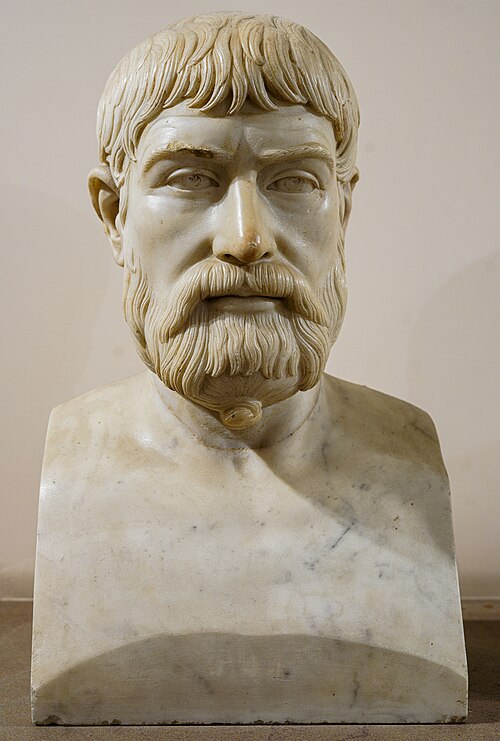
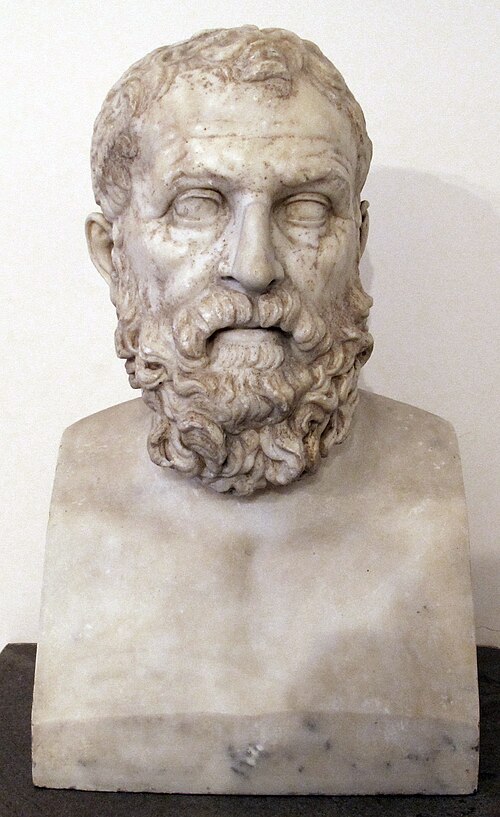
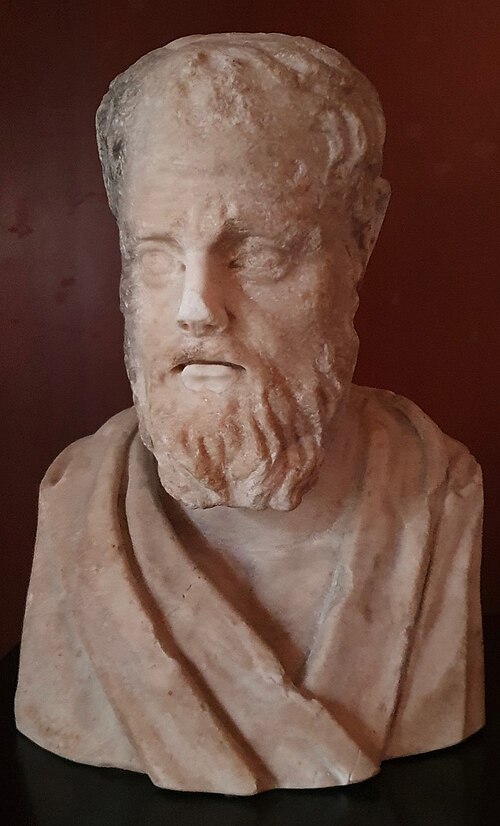
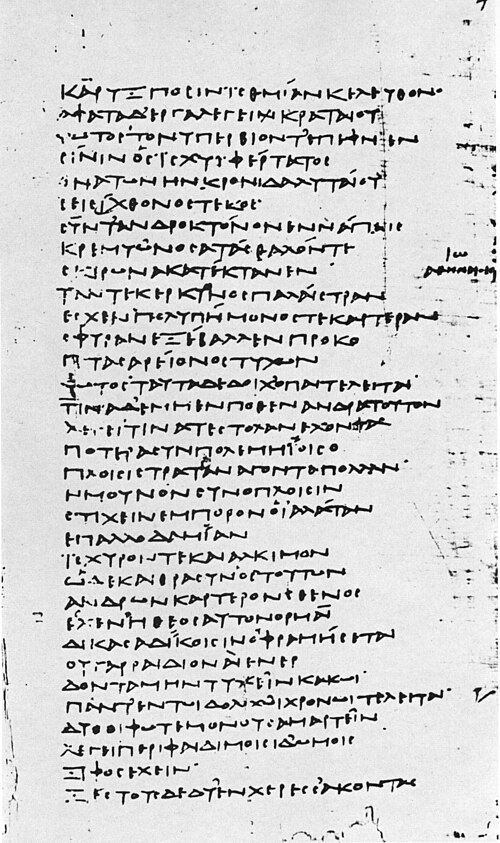
Hesiod
Yair Haklai · CC BY-SA 4.0 · Wikimedia Commons

C2Antiquity · Epic and didactic poet

Hesiod

Ησίοδος

c. 750–650 BC · Ascra, Boeotia (Mount Helicon)

Hesiod (Ησίοδος) was a farmer and shepherd from Ascra under Mount Helicon who lived around 700 BC, a generation or so after Homer. In the Θεογονία (Theogony) he told how the gods were born, from Chaos to the victory of Zeus; in Έργα και Ημέραι (Works and Days) he lectured his idle brother Perses about justice, Pandora's jar, the five ages of man and when to plough. He is the first Greek poet to tell us his own name.

Life

Hesiod is the earliest Greek writer to speak about himself, so his life, unlike Homer's, has a few fixed points. His father had been a sea-trader from Cyme in Asia Minor who gave up the sea and settled in Ascra, a village at the foot of Mount Helicon in Boeotia, a place Hesiod describes as bad in winter, harsh in summer and never good. There, while he was pasturing lambs on the mountain, the Muses appeared to him, gave him a staff of laurel and breathed a divine voice into him; so he tells it at the start of the Theogony.

When the father died, Hesiod's brother Perses took more than his share of the farm by bribing the local lords, whom Hesiod calls 'gift-eating kings', and then squandered it. The Works and Days is addressed to this brother, part reproach and part handbook, and it is the only ancient poem whose starting point is a family quarrel over an inheritance.

He mentions one journey: he crossed to Chalcis on Euboea for the funeral games of a nobleman, won the poetry contest with a hymn and dedicated the prize tripod to the Muses of Helicon. Later legend turned this into a contest with Homer himself. Nothing certain is known of his death; a late story says he was murdered in Locris and that dolphins carried his body to shore. Modern scholars place him around 700 BC, give or take a generation.

Works

The Θεογονία (Theogony) is the story of how the world and the gods came to be: first Chaos, then Earth, Tartarus and Eros; Earth bears Sky, and their son Cronus castrates his father with a sickle; Cronus swallows his own children until Rhea hides the baby Zeus in Crete; Zeus and the Olympians defeat the Titans and the monster Typhon, and Zeus divides the world. Woven in are Prometheus' trick with the sacrificial meat, the theft of fire and the making of the first woman as punishment. It is the nearest thing the Greeks had to a sacred book about origins.

Έργα και Ημέραι (Works and Days) is a sermon to Perses on justice and work. It explains why life is hard: Pandora opened a jar and released all evils, keeping only Hope inside; and the human race has declined through five ages, gold, silver, bronze, the heroes and the present iron age, in which Hesiod wishes he had not been born. Then comes practical advice: when to plough and reap, how to build a wagon, when the sea is safe, how to choose a wife, which days of the month are lucky. The tone is that of a shrewd, grumbling farmer who believes that Zeus sees everything.

A third poem under his name, the Ασπίς Ηρακλέους (Shield of Heracles), is probably later. His hexameters are plainer than Homer's, full of proverbs and lists, and gave the Greeks their standard version of the gods' family tree.

Legacy in Greece today

Herodotus wrote that Homer and Hesiod together gave the Greeks their gods, and Greek children still meet Hesiod's stories first: the third-grade history book is pure mythology, with Cronus swallowing his children, the war of the Titans and Pandora, all in his version. The κουτί της Πανδώρας, Pandora's box, is an everyday Greek expression, though in Hesiod it is a jar, and so is χρυσή εποχή, the golden age. You can walk the Valley of the Muses below Helicon, near the modern village of Askri, where the sanctuary he endowed with his tripod has been excavated. The line 'work is no disgrace, idleness is' is quoted in Greek schools and sermons. Six of his myths are retold on this site, from A1 Pandora to the C2 Theogony.

Did you know?

  • He is the first Greek poet to name himself: 'the Muses once taught Hesiod fine song as he was shepherding his lambs under holy Helicon'.
  • Pandora's 'box' is a mistranslation that spread in the Renaissance; Hesiod wrote πίθος, a large storage jar.
  • Works and Days ends with a calendar of lucky and unlucky days of the month, including the right day to geld a boar and the day on which to be born a boy.
  • His poem contains the oldest fable in Greek literature, the hawk and the nightingale, older than Aesop.

Key works

Greek titleTitleYear
ΘεογονίαTheogonyc. 700 BC
Έργα και ΗμέραιWorks and Daysc. 700 BC
Ο μύθος της Πανδώρας (Έργα 42–105)The myth of Pandora (Works and Days 42–105)c. 700 BC
Τα πέντε γένη (Έργα 106–201)The five ages of man (Works and Days 106–201)c. 700 BC
Ασπίς Ηρακλέους (αποδιδόμενη)Shield of Heracles (attributed)6th c. BC?

A line to remember

Ἔργον δ' οὐδὲν ὄνειδος, ἀεργίη δέ τ' ὄνειδος.

In today's GreekΗ δουλειά δεν είναι ντροπή· ντροπή είναι η τεμπελιά.

Ergon d' ouden oneidos, aergii de t' oneidos.

Work is no disgrace; it is idleness that is a disgrace.

Έργα και Ημέραι, στ. 311 (c. 700 BC)

From the original

The text as Hesiod wrote it, out of copyright, with our own translation beside it.

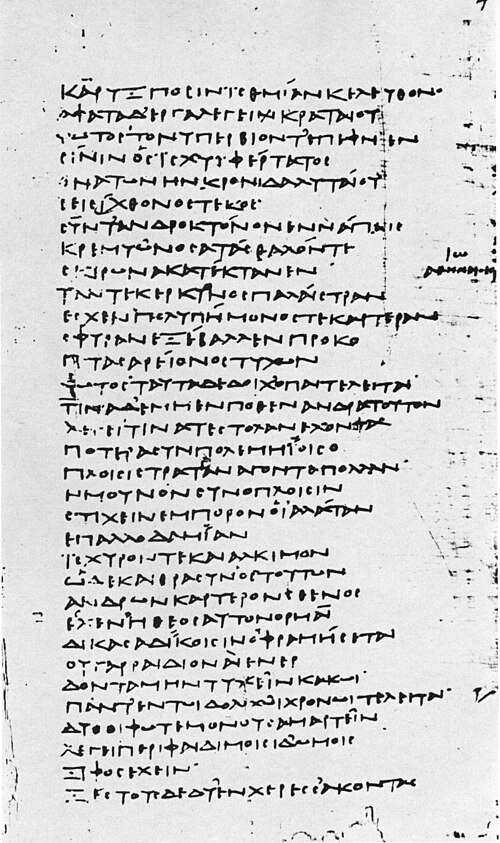
«Ἔργα καὶ ἡμέραι»Works and Days

The poem opens with a hymn to Zeus, who raises and humbles men at will, before Hesiod turns to his brother Perses. The advice on honest work quoted above comes later in the same poem.

Μοῦσαι Πιερίηθεν, ἀοιδῇσιν κλείουσαιMuses of Pieria, who bring glory with your songs,
δεῦτε, Δί᾽ ἐννέπετε, σφέτερον πατέρ᾽ ὑμνείουσαι·come, speak of Zeus, sing the praises of your father,
ὅν τε διὰ βροτοὶ ἄνδρες ὁμῶς ἄφατοί τε φατοί τε,through whom mortal men are alike unknown and well known,
ῥητοί τ᾽ ἄῤῥητοί τε Διὸς μεγάλοιο ἕκητι.named and nameless, as great Zeus wills.
ῥέα μὲν γὰρ βριάει, ῥέα δὲ βριάοντα χαλέπτει,For easily he makes strong, and easily he crushes the strong,
ῥεῖα δ᾽ ἀρίζηλον μινύθει καὶ ἄδηλον ἀέξει,easily he shrinks the conspicuous and makes the obscure grow,
ῥεῖα δέ τ᾽ ἰθύνει σκολιὸν καὶ ἀγήνορα κάρφειeasily he straightens the crooked and withers the proud,
Ζεὺς ὑψιβρεμέτης, ὃς ὑπέρτατα δώματα ναίει.Zeus who thunders on high, who dwells in the loftiest halls.
κλῦθι ἰδὼν ἀίων τε, δίκῃ δ᾽ ἴθυνε θέμισταςHear me, you who see and listen, and make judgments straight with justice,
τύνη· ἐγὼ δέ κε, Πέρση, ἐτήτυμα μυθησαίμην.you yourself; and I, Perses, would tell you true things.

Ἔργα καὶ ἡμέραι, lines 1–10 (the opening hymn to Zeus), c. 700 BC · Public-domain text, source: el.wikisource.org
C2

Read about Hesiod in Greek (C2)

Words from the passage

  • foothills
  • farmer
  • harvest, reaping
  • to bribe
  • inheritance
  • to swallow
  • sermon
  • storage jar

Test yourself: 4 words from this page

1 / 4

What does this word mean?

Want to learn Greek?Start learning Greek

Others at level C2

Modern Greece · Novelist, critic and satiristEmmanouil Roidis1836 – 1904Modern Greece · PoetAndreas Kalvos1792 – 1869Antiquity · Philosopher and prose writerPlatoc. 427 BC – c. 347 BCModern Greece · Revolutionary writer and poetRigas Feraiosc. 1757 – 1798Antiquity · PhilosopherAristotle384 BC – 322 BCAntiquity · HistorianThucydidesc. 460 BC – c. 400 BCAntiquity · Lyric poetPindarc. 518 BC – c. 438 BCRenaissance · Historian, Byzantine princessAnna Komnene1083 – c. 1153Renaissance · Archbishop and preacherJohn Chrysostomc. 347 – 407Renaissance · Byzantine historianProcopiusc. 500 – c. 565Modern Greece · Scholar of the Greek EnlightenmentAdamantios Korais1748 – 1833Modern Greece · Linguist, demoticistYannis Psycharis1854 – 1929Modern Greece · Surrealist poet and painterNikos Engonopoulos1907 – 1985Antiquity · SatiristLucian of Samosatac. 125 – after 180Antiquity · Lawgiver and poetSolonc. 630 BC – c. 560 BCModern Greece · SatiristAndreas Laskaratos1811 – 1901Modern Greece · NovelistKosmas Politis1888 – 1974Modern Greece · NovelistStratis Tsirkas1911 – 1980Modern Greece · Surrealist poet, psychoanalystAndreas Embirikos1901 – 1975Modern Greece · PoetMiltos Sachtouris1919 – 2005Modern Greece · NovelistMelpo Axioti1905 – 1973Modern Greece · Novelist, poetGiannis Skarimbas1893 – 1984Modern Greece · Philosopher, economist, psychoanalystCornelius Castoriadis1922 – 1997Modern Greece · Composer, architectIannis Xenakis1922 – 2001Modern Greece · Prose writerGiorgos Ioannou1927 – 1985Modern Greece · Novelist, playwrightPavlos Matesis1933 – 2013Modern Greece · LinguistManolis Triantafyllidis1883 – 1959Modern Greece · HistorianKonstantinos Paparrigopoulos1815 – 1891Modern Greece · Engraver, printmakerVaso Katraki1914 – 1988Modern Greece · Philosopher, jurist, PresidentKonstantinos Tsatsos1899 – 1987Modern Greece · PhilosopherIoannis Theodorakopoulos1900 – 1981Modern Greece · Short-story writer · teacherAlexandra Papadopoulou1867 – 1906Modern Greece · Folklorist · anthropologistAlki Kyriakidou-Nestoros1935 – 1988Modern Greece · Actor · stage directorAnna KokkinouModern Greece · Stage and film actressAntigoni Valakou1930 – 2013Antiquity · PainterApellesAntiquity · Grammarian and editorAristophanes of Byzantiumc. 257 BC – c. 180 BCModern Greece · Novelist; linguistDimitra Kolliakou1968Modern Greece · Theatre directorDimitris Rontiris1899 – 1981Modern Greece · Singer · songwriterEleni Vitali1954Modern Greece · Novelist · educatorElli Alexiou1894 – 1988Modern Greece · Singer · composerGiorgos Alkaios1971Antiquity · Orator and educatorIsocrates436 BC – 338 BCModern Greece · Stage and screen actorKaryofyllia Karabeti1958Modern Greece · Pop singerKostas Martakis1984Modern Greece · Stage director · actorLefteris Vogiatzis1944 – 2013Modern Greece · Choreographer · dancerLenio Kaklea1985Modern Greece · Novelist; journalistLilika Nakou1904 – 1989Modern Greece · Novelist · short-story writerMaria Mitsora1946Modern Greece · Singer · actress · directorMartha Frintzila1972Modern Greece · Actress · musical starMartha Karagianni1939 – 2022Modern Greece · Actor · stage and screenMirka Papakonstantinou1947Modern Greece · SculptorNausica Pastra1921 – 2011Modern Greece · Poet · prose writer · painterNiki Marangou1948 – 2013Modern Greece · ActressNora Valsami1945Modern Greece · PoetOlga Votsi1922 – 1998Antiquity · Bronze sculptor and art theoristPolykleitosModern Greece · Stage actressReni Pittakic. 1945Modern Greece · Singer · stage performerRita AntonopoulouModern Greece · Pop singerSarbel1981Modern Greece · Novelist · teacherSofia Nikolaidou1968Modern Greece · Film director · screenwriterStavros Tsiolis1937 – 2019Modern Greece · Singer · actressStefania Liberakakis2002Modern Greece · Rapper · producerStereo Mike1978Antiquity · Choral lyric poetBacchylidesc. 510 BCModern Greece · Stage actorVera Zavitsianou1927 – 2008Modern Greece · Playwright · actressXenia Kalogeropoulou1936

All personalities →